
FTA Decision No. 6 of 2026: QFZP Distribution Compliance
Learn how FTA Decision No. 6 of 2026 changes QFZP distribution compliance, auditor requirements, documentation, and AUP reporting under UAE Corporate Tax.

1. New Compliance Requirements for QFZP Distribution Activities

FTA Decision No. 6 of 2026: Complete Guide to QFZP Distribution Compliance in UAE Designated Zones
The UAE Corporate Tax regime continues to evolve as the Federal Tax Authority (FTA) introduces more detailed compliance requirements for businesses operating in Free Zones. One of the most significant developments for 2026 is FTA Decision No. 6 of 2026, which establishes additional compliance procedures for Qualifying Free Zone Persons (QFZPs) engaged in the qualifying activity of distributing goods or materials in or from a Designated Zone.
Unlike previous guidance that primarily explained eligibility, this Decision focuses on how businesses must demonstrate compliance. It introduces mandatory documentation, independent auditor procedures, prescribed sampling methodologies, and submission deadlines designed to verify that taxpayers genuinely satisfy the conditions for this qualifying activity.
For distributors operating in UAE Free Zones, the Decision represents a shift from principle-based compliance to an evidence-based framework. Businesses will need to maintain detailed records throughout the tax period rather than attempting to assemble supporting documents only at year-end.
This guide explains the practical implications of FTA Decision No. 6 of 2026, identifies the businesses affected, outlines the new compliance obligations, and provides practical recommendations to help taxpayers prepare for implementation.
What is FTA Decision No. 6 of 2026?
FTA Decision No. 6 of 2026 determines the additional compliance procedures applicable to Qualifying Free Zone Persons carrying on the qualifying activity of distributing goods or materials in or from a Designated Zone.
The Decision was issued on 2 June 2026 and applies to tax periods beginning on or after 1 January 2026. Rather than creating a new qualifying activity, it establishes the documentary evidence, audit procedures, and reporting requirements that businesses must satisfy to support compliance with the existing Corporate Tax framework. :contentReference[oaicite:2]{index=2}
Among the most notable requirements is the obligation to obtain an Agreed-Upon Procedures (AUP) Report prepared by an independent external auditor in accordance with ISRS 4400 – Agreed-Upon Procedures Engagements. The report provides factual findings on whether specified compliance procedures have been performed; it is not an audit opinion. :contentReference[oaicite:3]{index=3}
Why Was This Decision Introduced?
The UAE Corporate Tax regime provides a preferential tax framework for Qualifying Free Zone Persons that satisfy the conditions prescribed under the Corporate Tax Law and related implementing decisions. As the regime has matured, the FTA has progressively clarified how taxpayers should evidence compliance in practice.
FTA Decision No. 6 of 2026 addresses a key compliance challenge: verifying that businesses claiming to undertake qualifying distribution activities genuinely satisfy the relevant conditions. Instead of relying solely on declarations, the Decision requires independent verification supported by documentary evidence and standardized procedures.
The Decision therefore promotes greater consistency in compliance reviews by:
- Establishing uniform documentation requirements.
- Standardising auditor procedures.
- Introducing prescribed sampling methodologies.
- Providing objective evidence to support Corporate Tax compliance.
- Reducing uncertainty during FTA reviews.
These measures also encourage businesses to strengthen their internal governance, record-keeping, and operational controls throughout the financial year rather than treating compliance as a year-end exercise.
Who Does This Decision Apply To?
A common misconception is that every Free Zone company must comply with this Decision. That is not the case.
The Decision applies specifically to Qualifying Free Zone Persons carrying out the qualifying activity of distributing goods or materials in or from a Designated Zone. Businesses performing other qualifying activities are not automatically subject to these additional procedures unless they also undertake this specific distribution activity. :contentReference[oaicite:4]{index=4}
| Business Type | Generally Within Scope? | Explanation |
|---|---|---|
| QFZP distributing goods from a Designated Zone | ✔ Yes | Subject to the additional compliance procedures described in the Decision. |
| QFZP importing goods through a Designated Zone for qualifying distribution | ✔ Yes | Must maintain import documentation and satisfy the prescribed procedures. |
| QFZP carrying on unrelated qualifying activities only | ✖ Generally No | The additional procedures target the qualifying distribution activity. |
| Mainland businesses | ✖ No | The Decision applies only to Qualifying Free Zone Persons carrying on the specified qualifying activity. |
Businesses with mixed activities should carefully evaluate whether any part of their operations falls within the qualifying distribution activity, as this may trigger the additional compliance requirements introduced by the Decision.
Understanding the Qualifying Distribution Activity
The qualifying activity addressed by this Decision relates to the distribution of goods or materials in or from a Designated Zone. However, simply purchasing and selling goods is not sufficient. The Decision focuses on demonstrating that customers acquire the goods for onward resale or qualifying processing activities and that imported goods enter the UAE through a Designated Zone where applicable. :contentReference[oaicite:5]{index=5}
Accordingly, businesses should be prepared to demonstrate:
- Who their customers are.
- Whether those customers operate as resellers.
- The commercial purpose of the transactions.
- How imported goods entered the UAE.
- Whether internal inventory and logistics records support the movement of goods.
These requirements significantly increase the importance of maintaining robust commercial documentation, customs records, and inventory controls throughout the tax period.
In the next part of this guide, we examine the new compliance requirements in detail, including the mandatory Agreed-Upon Procedures Report, documentation standards, auditor testing procedures, sampling methodology, submission deadlines, and practical compliance recommendations.
2. What Changed, AUP Report, Documentation, Auditor Procedures & Compliance

What's New Under FTA Decision No. 6 of 2026?
While the UAE Corporate Tax framework has already identified distribution of goods or materials in or from a Designated Zone as a qualifying activity under specific conditions, FTA Decision No. 6 of 2026 introduces the operational framework for proving compliance.
Instead of creating a new tax incentive, the Decision establishes the evidence, procedures, documentation, and reporting expected by the Federal Tax Authority (FTA) to support a taxpayer's eligibility for this qualifying activity.
For many businesses, this represents a significant shift from maintaining general commercial records to implementing a structured compliance framework capable of withstanding regulatory review.
| Area | Before Decision No. 6 of 2026 | After Decision No. 6 of 2026 |
|---|---|---|
| Compliance Evidence | General supporting records | Detailed documentary evidence prescribed by the FTA |
| Independent Verification | Not specifically prescribed for this activity | Mandatory Agreed-Upon Procedures (AUP) Report |
| Auditor Procedures | No standardized testing methodology | Specific testing procedures under ISRS 4400 |
| Sampling | Professional judgement | Prescribed statistical sampling formula |
| Submission Requirement | No dedicated AUP submission requirement | Report due within 30 days after the Corporate Tax return filing deadline |
The practical implication is clear: qualifying businesses must be prepared to demonstrate compliance with objective evidence rather than relying solely on declarations or contractual arrangements.
Mandatory Agreed-Upon Procedures (AUP) Report
The centrepiece of FTA Decision No. 6 of 2026 is the requirement for an Agreed-Upon Procedures (AUP) Report.
This report must be prepared by an independent external auditor responsible for the statutory audit of the financial statements, or by another independent auditor licensed in the UAE. The engagement must be conducted in accordance with International Standard on Related Services (ISRS) 4400 – Agreed-Upon Procedures Engagements. Unlike a statutory audit, an AUP engagement does not express an audit opinion. Instead, the auditor performs specific procedures agreed under the Decision and reports factual findings. :contentReference[oaicite:0]{index=0}
Purpose of the AUP Report
The report is intended to demonstrate two key matters:
- That customers purchasing the goods or materials satisfy the reseller conditions prescribed under the relevant Corporate Tax framework.
- That imported goods or materials entering the UAE were imported through a Designated Zone where applicable.
Accordingly, businesses should view the AUP report as a structured compliance verification exercise rather than a traditional financial audit.
Documentation Requirements
One of the most significant aspects of the Decision is the extensive documentary evidence that businesses are expected to collect, maintain, and retain.
Customer Documentation
To demonstrate that customers qualify as resellers, businesses should maintain documentation such as:
- Valid trade licences or commercial licences.
- Business licences indicating trading, distribution, manufacturing, or resale activities.
- Signed customer declarations confirming goods are acquired for resale or qualifying onward supply.
- Sales agreements.
- Purchase orders.
- Commercial invoices.
- Transaction records supporting resale activity.
| Document | Purpose |
|---|---|
| Trade Licence | Evidence of reseller activity |
| Customer Declaration | Confirms commercial intention |
| Sales Agreement | Supports contractual relationship |
| Invoice | Evidence of qualifying transaction |
| Purchase Order | Supports transaction trail |
Import Documentation
Where goods enter the UAE through a Designated Zone, businesses should retain documentation demonstrating the import route.
- Import declarations.
- Customs clearance documents.
- Bills of lading.
- Airway bills.
- Shipping documentation.
- Import permits where applicable.
- Transport documentation.
| Document | Purpose |
|---|---|
| Import Declaration | Confirms importation |
| Customs Documents | Evidence of lawful import |
| Bill of Lading | Shipping evidence |
| Airway Bill | Air freight evidence |
| Import Permit | Supports customs records |
Internal Business Records
The Decision also recognises the importance of internal operational controls. Businesses should maintain records demonstrating how goods move through the Designated Zone before distribution.
- Inventory registers.
- Warehouse reports.
- Goods movement records.
- Logistics documentation.
- Receiving reports.
- Stock transfer records.
- Distribution logs.
These records help establish that imported goods were received, handled, stored, and distributed in accordance with the qualifying activity requirements.
Auditor Testing Procedures
The Decision prescribes detailed procedures that the independent auditor must perform during the AUP engagement.
1. Inspection of Customer Trade Licences
The auditor will inspect customer licences to determine whether the business activities indicate trading, wholesaling, retailing, manufacturing, or other activities consistent with resale.
2. Verification of Customer Declarations
The auditor will review signed customer declarations confirming that goods are acquired for resale, further processing for sale, or qualifying onward supply.
3. Review of Commercial Agreements
The auditor will inspect sales agreements, invoices, and other commercial records to identify contractual terms supporting resale activities.
4. Import Verification
Import declarations, customs documentation, transport documents, and shipping records will be reviewed to verify that imported goods entered the UAE through a Designated Zone.
5. Confirmation of Designated Zone Status
The auditor will verify that the Free Zone used for importation is officially recognised as a Designated Zone under the applicable UAE legislation.
6. Review of Internal Records
Warehouse records, inventory logs, logistics reports, and goods movement records will be examined to support the importation and distribution process.
Sampling Methodology
Unlike many compliance engagements that rely solely on professional judgement, the Decision introduces a prescribed sampling methodology.
The sample size must be determined using the following formula:
Sample Size = Sample Population ÷ (1 + Sample Population × Margin of Error²)
The Decision specifies a 10% Margin of Error. This approach provides consistency across engagements and ensures that higher-value customers, agreements, and import transactions are included within the testing population. :contentReference[oaicite:1]{index=1}
Illustrative Example
| Sample Population | Approximate Sample Size |
|---|---|
| 100 customers | 50 |
| 500 customers | 83 |
| 1,000 customers | 91 |
These calculations are illustrative only. Businesses should rely on the methodology prescribed in the Decision and agree the final sampling approach with the independent auditor.
Submission Deadline
The completed Agreed-Upon Procedures Report must be submitted to the Federal Tax Authority within 30 days after the Corporate Tax return filing deadline, unless another deadline is specified by the Authority. Businesses should therefore coordinate with their auditors well before the Corporate Tax filing deadline to avoid delays in completing the engagement. :contentReference[oaicite:2]{index=2}
Practical Example
ABC FZE operates from a UAE Designated Zone and imports electronic components through the Designated Zone before supplying them to UAE wholesalers for onward resale.
To support compliance under FTA Decision No. 6 of 2026, ABC FZE maintains:
- Customer trade licences.
- Signed reseller declarations.
- Sales agreements.
- Purchase orders.
- Commercial invoices.
- Import declarations.
- Bills of lading.
- Warehouse inventory records.
- Goods movement reports.
During the AUP engagement, the independent auditor selects samples using the prescribed methodology, verifies the supporting documentation, and issues the Agreed-Upon Procedures Report containing factual findings.
QFZP Compliance Checklist
| Compliance Item | Status |
|---|---|
| Identify qualifying distribution activity | ☐ |
| Maintain customer licences | ☐ |
| Collect reseller declarations | ☐ |
| Maintain commercial agreements | ☐ |
| Maintain customs documentation | ☐ |
| Maintain warehouse records | ☐ |
| Maintain inventory movement logs | ☐ |
| Appoint an independent auditor | ☐ |
| Complete the AUP engagement | ☐ |
| Submit the report within the prescribed deadline | ☐ |
In Part 3, we cover the consequences of non-compliance, common mistakes, expert insights, frequently asked questions, conclusion, and a conversion-focused call to action.
3. Non-Compliance, Best Practices, FAQs & Conclusion
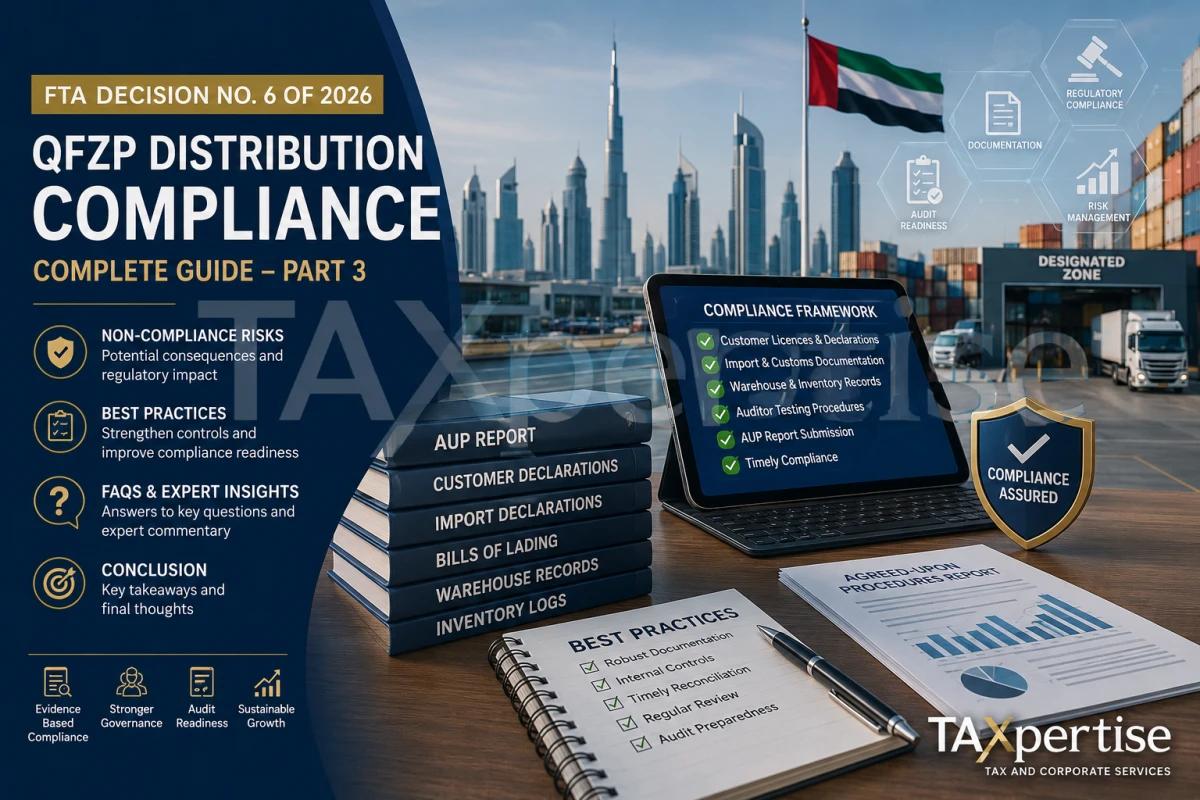
Consequences of Non-Compliance
FTA Decision No. 6 of 2026 is not merely an administrative requirement. The additional procedures introduced by the Decision form part of the evidence expected to demonstrate compliance with the qualifying distribution activity under the UAE Corporate Tax regime.
If a Qualifying Free Zone Person (QFZP) cannot demonstrate compliance with these requirements, the Federal Tax Authority (FTA) may conclude that the taxpayer has not adequately substantiated its eligibility in respect of this qualifying activity. This could affect the taxpayer's Corporate Tax position depending on the facts and circumstances of the case and the application of the Corporate Tax Law and related decisions. :contentReference[oaicite:0]{index=0}
Potential Risks
- Failure to demonstrate compliance during an FTA review.
- Inability to substantiate qualifying distribution transactions.
- Additional information requests from the FTA.
- Extended Corporate Tax audits.
- Increased compliance costs.
- Potential reassessment where statutory conditions are not demonstrated.
Accordingly, businesses should treat the Decision as an operational compliance framework rather than a year-end reporting exercise.
Common Compliance Mistakes
During implementation, businesses commonly focus on maintaining invoices while overlooking the broader documentation expected under the Decision.
| Common Mistake | Potential Impact | Recommended Action |
|---|---|---|
| Collecting invoices only | Incomplete audit trail | Maintain the complete supporting documentation package. |
| No customer reseller declaration | Difficulty demonstrating customer eligibility | Obtain signed declarations before or during the transaction. |
| Incomplete customs documentation | Unable to verify import route | Maintain all import and customs records. |
| Poor warehouse records | Inventory movement cannot be demonstrated | Implement warehouse tracking procedures. |
| Late appointment of external auditor | Delayed AUP report | Engage the auditor early in the financial year. |
| Waiting until year-end | Missing documentation | Collect compliance evidence continuously. |
Best Practices for QFZPs
Businesses should integrate the Decision into their internal compliance framework rather than treating it as an isolated Corporate Tax requirement.
Recommended Internal Controls
- Create a customer onboarding process that includes reseller verification.
- Maintain digital copies of all customer licences.
- Require reseller declarations before completing sales.
- Maintain centralized customs documentation.
- Reconcile inventory movements monthly.
- Link warehouse records with accounting software.
- Retain all logistics documentation electronically.
- Conduct quarterly internal compliance reviews.
- Perform annual mock compliance testing before the statutory AUP engagement.
- Appoint the external auditor well before the Corporate Tax filing deadline.
Implementing these controls reduces the risk of missing documentation and significantly improves readiness for FTA reviews.
Timeline for Compliance
| Stage | Recommended Timing |
|---|---|
| Customer onboarding | Before first sale |
| Customer declaration | At commencement of business relationship |
| Import documentation | Each import transaction |
| Warehouse documentation | Continuous |
| Inventory reconciliation | Monthly |
| Internal compliance review | Quarterly |
| Appointment of auditor | Before year-end |
| AUP Engagement | Immediately after year-end |
| Submission to FTA | Within prescribed deadline |
Frequently Asked Questions (FAQs)
1. Does FTA Decision No. 6 of 2026 apply to every Free Zone company?
No. The Decision applies specifically to Qualifying Free Zone Persons carrying on the qualifying activity of distributing goods or materials in or from a Designated Zone. Businesses undertaking other activities should assess whether the Decision applies based on their facts and circumstances. :contentReference[oaicite:1]{index=1}
2. Is the AUP Report the same as an external audit?
No. An Agreed-Upon Procedures (AUP) engagement under ISRS 4400 differs from a statutory audit. The auditor performs specified procedures and reports factual findings rather than expressing an audit opinion. :contentReference[oaicite:2]{index=2}
3. Who may prepare the AUP Report?
The report must be prepared by an eligible independent external auditor in accordance with the requirements prescribed by the Decision. :contentReference[oaicite:3]{index=3}
4. Are customer declarations mandatory?
The Decision requires procedures to verify that customers satisfy the relevant reseller conditions. Customer declarations are one of the key documents commonly used to support this verification together with commercial documentation and trade licences. :contentReference[oaicite:4]{index=4}
5. What documents should businesses retain?
Businesses should maintain customer licences, reseller declarations, invoices, agreements, purchase orders, import declarations, customs documentation, warehouse records, inventory reports, and logistics records supporting the qualifying activity.
6. When does the Decision apply?
The Decision applies to tax periods beginning on or after 1 January 2026. :contentReference[oaicite:5]{index=5}
Expert Commentary
FTA Decision No. 6 of 2026 marks a significant evolution in the UAE Corporate Tax regime. Rather than expanding the scope of qualifying activities, it establishes a structured evidence-based compliance framework for one of the most commercially significant Free Zone activities—distribution of goods or materials.
Businesses that embed these requirements into their operational processes from the outset will generally be better positioned for Corporate Tax compliance than those attempting to reconstruct supporting documentation after the financial year has ended.
The Decision also signals the FTA's broader emphasis on governance, auditability, and verifiable evidence. Similar compliance-focused measures may be introduced for other qualifying activities as the Corporate Tax regime continues to mature.
Final Thoughts
FTA Decision No. 6 of 2026 provides practical guidance on how Qualifying Free Zone Persons engaged in qualifying distribution activities should demonstrate compliance under the UAE Corporate Tax framework.
The Decision introduces mandatory Agreed-Upon Procedures reporting, detailed documentary evidence requirements, prescribed auditor procedures, and defined submission timelines. Together, these measures promote greater consistency, transparency, and accountability within the UAE's Free Zone Corporate Tax regime.
Businesses should review their existing compliance processes, strengthen internal controls where necessary, and engage their advisors and external auditors well before the Corporate Tax filing deadline to ensure that all documentary requirements are satisfied.
Need Professional Assistance?
TAXpertise assists businesses across the UAE with:
- Corporate Tax Advisory
- QFZP Eligibility Assessments
- Designated Zone Compliance
- Agreed-Upon Procedures (AUP) Readiness
- Corporate Tax Health Checks
- Transfer Pricing Documentation
- FTA Audit Support
- Corporate Tax Return Preparation
Contact TAXpertise today to ensure your business is fully prepared for the new compliance framework introduced by FTA Decision No. 6 of 2026.
Featured Snippet
What's Your Reaction?
 Like
0
 Dislike
0
 Love
0
 Funny
0
 Wow
0
 Sad
0
 Angry
0


Comments (0)