
UAE Corporate Tax Accounting Standards | IFRS, Accrual & Audit Rules
UAE Corporate Tax requires IFRS-based accounting, accrual recognition, and strict audit rules. Learn what businesses must comply with before filing.

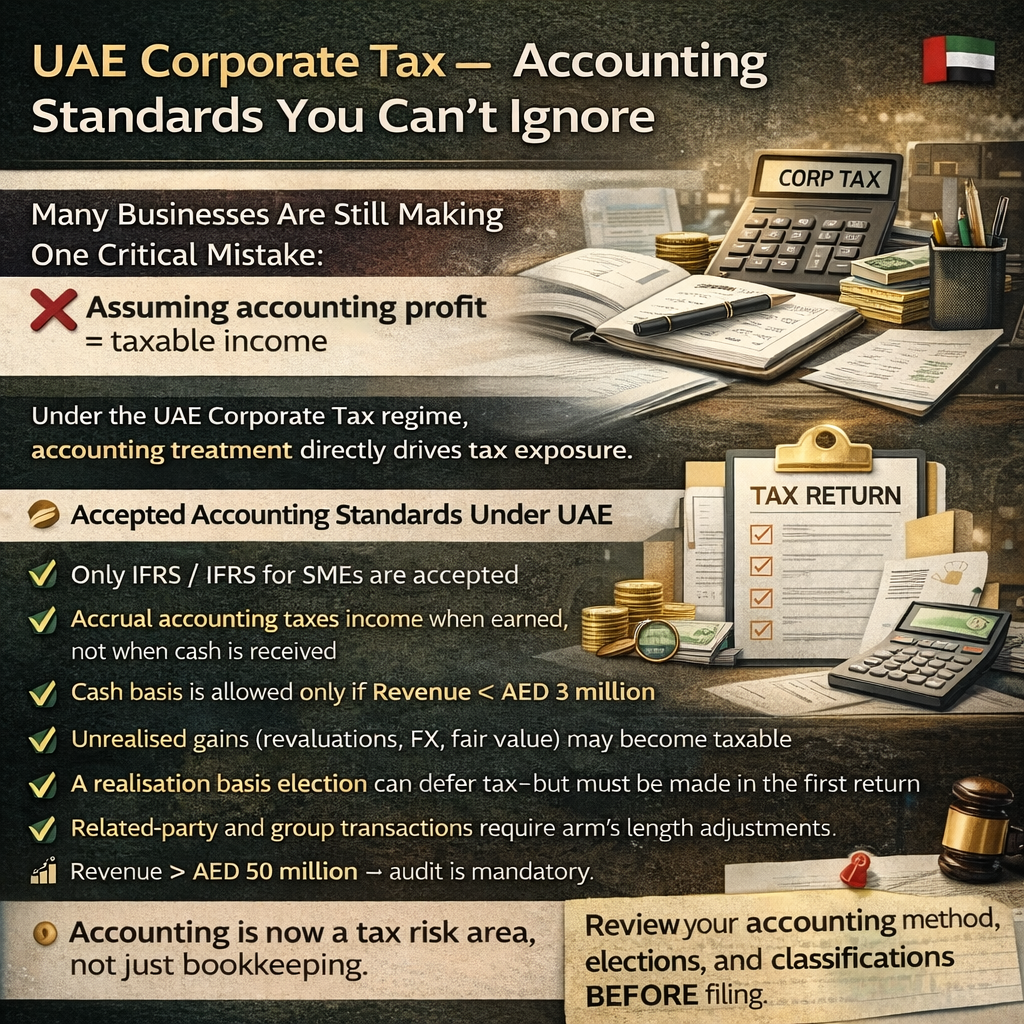
🟢 UAE Corporate Tax – Accounting Standards You Can’t Ignore
Many UAE businesses are still making one critical and costly mistake:
❌ Assuming accounting profit equals taxable income
Under the UAE Corporate Tax regime, accounting treatment directly drives tax exposure. Accounting is no longer just bookkeeping — it is now a primary tax risk area.
🔹 Accepted Accounting Standards Under UAE Corporate Tax
The Federal Tax Authority (FTA) allows only the following:
✔ IFRS
✔ IFRS for SMEs
Any deviation, non-standard practices, or inconsistent policies may result in tax adjustments, penalties, or audit exposure.
🔹 Accrual vs Cash Basis – Know the Difference
🔸 Accrual Accounting (Default Rule)
-
Income is taxed when earned, not when cash is received
-
Expenses are recognized when incurred
-
This is the default and expected method under UAE Corporate Tax
🔸 Cash Basis (Limited Exception)
✔ Allowed only if annual revenue ≤ AED 3 million
❌ Above AED 3 million → cash basis not permitted
🔹 Unrealised Gains Can Become Taxable
Under IFRS-based accounting:
-
Fair value gains
-
Revaluation surpluses
-
Unrealised foreign exchange gains
⚠️ May become taxable, even without cash movement.
🔹 Realisation Basis Election (One-Time Decision)
✔ Businesses may elect to be taxed only on realised gains
✔ This election can defer tax exposure
❗ Critical rule:
➡️ The election must be made in the FIRST Corporate Tax return
➡️ Missed election = permanent loss of option
🔹 Related-Party & Group Transactions
Transactions with:
-
Directors
-
Shareholders
-
Group companies
-
Connected persons
Must be:
✔ At arm’s length
✔ Properly documented
✔ Adjusted where accounting does not reflect market value
FTA scrutiny in this area is high.
🔹 Audit Requirement – AED 50 Million Threshold
📌 If Revenue > AED 50 million:
✔ Statutory audit becomes mandatory for Corporate Tax purposes
✔ Poor-quality financials = high audit and penalty risk
🚨 Why This Matters
📌 Accounting errors now lead directly to:
-
Higher taxable income
-
Denied deductions
-
Transfer pricing adjustments
-
Audit exposure
-
Penalties
Accounting is now a Corporate Tax risk function, not a back-office task.
✅ What Businesses Should Do Now
✔ Review accounting standards applied
✔ Confirm accrual vs cash eligibility
✔ Assess unrealised gains exposure
✔ Evaluate realisation basis election
✔ Review related-party transactions
✔ Prepare audit-ready financials
🔍 Fix accounting issues before filing — not after an FTA notice.
What's Your Reaction?
 Like
0
 Dislike
0
 Love
0
 Funny
0
 Wow
0
 Sad
0
 Angry
0









Comments (0)