
FTA Decision No. 13 of 2026: New UAE VAT Supplier and Supply Verification Requirements from 1 October 2026
Learn how FTA Decision No. 13 of 2026 changes UAE VAT Input Tax verification from 1 October 2026, including supplier due diligence, AED 375,000 threshold, risk indicators and documentation requirements.

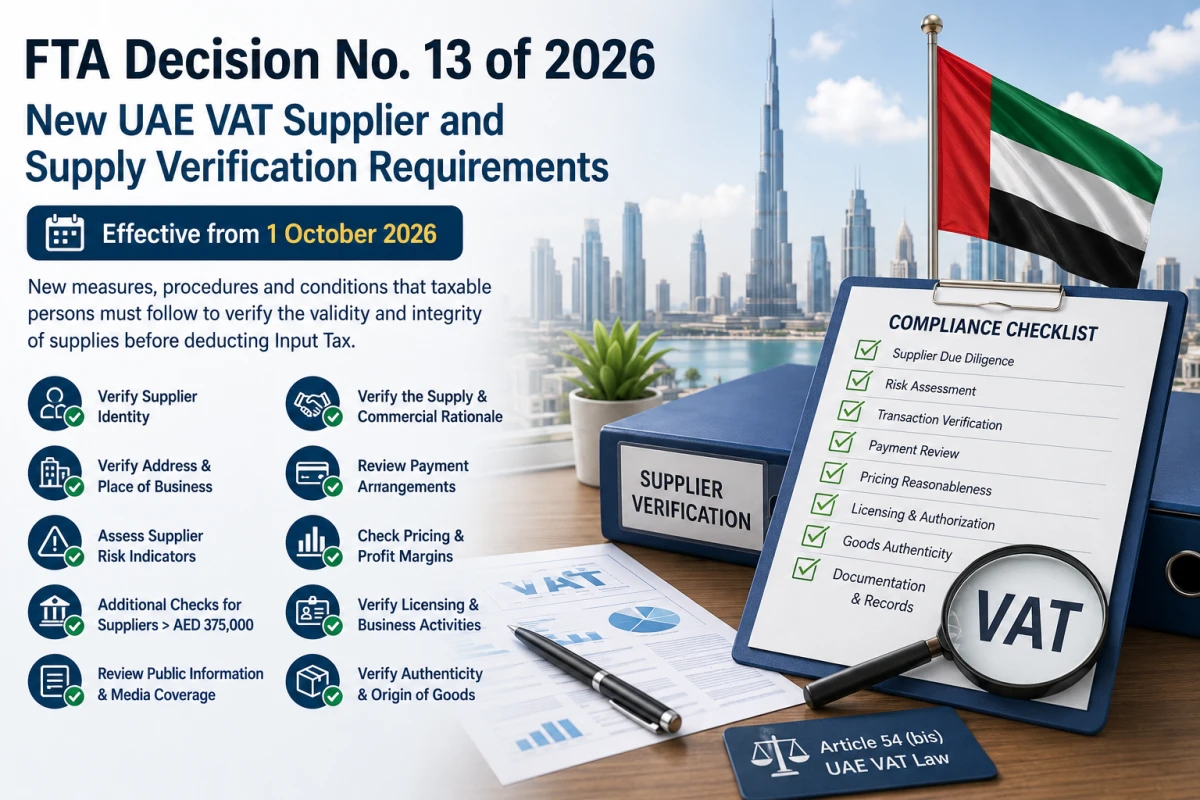
Federal Tax Authority Decision No. 13 of 2026 introduces new measures, procedures and conditions that taxable persons in the United Arab Emirates must follow to verify the validity and integrity of supplies before deducting Input Tax.
The Decision was issued on 22 July 2026 and will come into effect on 1 October 2026. It establishes a more structured approach to supplier due diligence, transaction verification, payment review, risk assessment and documentation for UAE Value Added Tax purposes.
Read the official Federal Tax Authority Decision No. 13 of 2026
What is FTA Decision No. 13 of 2026?
FTA Decision No. 13 of 2026 sets out the measures, procedures and conditions required by taxable persons for verifying the validity and integrity of supplies before deducting Input Tax.
The Decision applies in connection with the requirements of Article 54(bis) of the UAE Value Added Tax Law and focuses on whether businesses have undertaken appropriate verification of:
- The identity of their suppliers;
- The supplier's address and place of business;
- Risks associated with the supplier;
- Certain higher-value suppliers;
- The commercial circumstances of the transaction;
- Payment arrangements;
- Pricing and profit margins;
- The nature and authenticity of goods and services; and
- The supplier's authority to provide or dispose of the goods.
Importantly, the Decision also requires taxable persons to document the verification procedures performed and retain supporting evidence.
When does FTA Decision No. 13 of 2026 take effect?
The Decision will become effective from:
1 October 2026
It was issued on 22 July 2026 and is to be published in the Official Gazette before coming into effect.
This gives businesses a limited preparation period to review their existing procurement, accounts payable and VAT control procedures.
What must businesses verify before deducting Input Tax?
The Decision divides the verification requirements broadly into two areas:
- Verification of the supplier
- Verification of the supply
These requirements should be incorporated into the business's VAT compliance and procurement controls.
1. Verify the identity of the supplier
A taxable person must verify the identity of the supplier.
The verification requirements differ depending on whether the supplier is a natural person or a legal person.
Where the supplier is a natural person
The taxable person must:
- Obtain a copy of valid proof of identity, such as an Emirates ID or passport; and
- Meet the supplier either physically or virtually before the supply is made.
Where the supplier is a legal person
The taxable person must verify the supplier's incorporation through:
- Official databases; or
- A copy of the certificate of incorporation.
The incorporation details should be valid and consistent with information relating to the entity, including its:
- Name;
- Address;
- Employees; and
- Other relevant information.
The identity of the director, agent or employee authorised to represent the supplier must also be verified through valid identification documentation, such as an Emirates ID or passport.
Practical implication
A valid tax invoice alone should no longer be viewed as the entire supplier onboarding control.
Businesses should consider maintaining a supplier verification file containing the relevant identification and corporate documentation.
2. Verify the supplier's address and place of business
The taxable person must verify that the supplier has an actual place of business.
This can be established using:
- Appropriate electronic means; or
- A field visit to the supplier's place of business.
The business premises should also be compatible with the nature of the supplier's commercial activities.
Example
If a supplier claims to conduct substantial trading activities but the available information indicates that the supplier has no appropriate business premises or operational presence, this may require further investigation.
The purpose is not simply to collect an address. The taxable person needs to have reasonable evidence supporting the supplier's actual business presence.
3. Assess supplier risk indicators
FTA Decision No. 13 of 2026 specifically identifies three supplier risk indicators.
Businesses must consider whether:
1. The supplier changed its address more than twice during the previous 12 months
Frequent changes of address may require additional explanation and supporting evidence.
2. The supplier changed key employees more than twice during the previous 12 months
This includes supplier managers or individuals with whom the taxable person deals.
3. The supplier's transactions are disproportionate or unexpected
The taxable person should consider whether the supplier's transaction volumes, values or nature are inconsistent with:
- The size of the supplier's business; or
- The supplier's historical business activities.
If one of these indicators applies, the taxable person must retain a clear and justified explanation and provide it to the Federal Tax Authority if requested. The explanation should not contradict the evidence or information available to the taxable person.
4. Additional checks for suppliers exceeding AED 375,000
One of the most important thresholds under the Decision is AED 375,000.
Where the value of supplies received from a supplier:
- Exceeded AED 375,000 during the previous 12 months, or
- Is expected to exceed AED 375,000 during the next 12 months,
additional verification requirements apply.
The taxable person must:
- Verify that the supplier has a bank account; and
- Review available client recommendations and publicly available information relating to the supplier.
Bank account confirmation
The taxable person must obtain written confirmation from an authorised bank in the UAE confirming that the supplier maintains a bank account.
The confirmation must not contain relevant reservations or conditions.
The Decision also clarifies that the confirmation does not necessarily have to be issued directly to the recipient of the supply.
Practical compliance point
Businesses should consider incorporating supplier bank-account verification into their vendor onboarding or periodic supplier review procedures, particularly for significant suppliers.
5. Review publicly available information and media coverage
For suppliers exceeding the AED 375,000 threshold, businesses must review and assess:
- Publicly available reviews; and
- Media coverage
from reliable sources.
The information should be assessed against:
- The nature of the supplier's business;
- The size of the supplier's business; and
- Potential indicators of suspected Tax Evasion.
This means that supplier due diligence can extend beyond the documents supplied directly by the vendor.
6. Verify the supply itself
Supplier verification is only one part of the new framework.
The taxable person must also verify the actual supply received.
FTA Decision No. 13 of 2026 requires a general assessment of the supply and its transaction conditions.
The business should ensure that the supplier's participation in the transaction is based on genuine commercial reasons.
7. Review the payment arrangements
The payment method and payment conditions must be commercially justifiable.
Where a third party is involved in:
- Making the payment; or
- Receiving the payment,
there must be a reasonable commercial explanation.
Similarly, where payment is made into a bank account outside the supplier's country of incorporation, the taxable person should have a reasonable commercial explanation that is consistent with the available evidence.
Electronic payments
The consideration for the supply should be paid by electronic means.
Where payment is made in cash, the cash payment must:
- Have a documented commercial reason;
- Fall within the applicable thresholds under UAE tax legislation; and
- Be readily verifiable.
This makes payment documentation an increasingly important part of the VAT audit trail.
8. Check whether the pricing is commercially reasonable
The taxable person must verify that the price or profit margin is not:
- Commercially unjustifiable; or
- Significantly different from market conditions without a clear reason.
This does not mean that every purchase must be supported by a formal transfer pricing-style benchmarking exercise.
Rather, the business should be able to explain unusual pricing where the price or margin appears significantly inconsistent with normal market conditions.
9. Check whether the supplier is licensed to provide the goods or services
Another important requirement is to verify that the goods or services supplied do not fall outside:
- The supplier's ordinary business activities; or
- The activities that the supplier is licensed to perform under its commercial licence.
This creates an important link between supplier due diligence, commercial licensing and VAT compliance.
Example
If a supplier's commercial licence does not appear to cover the nature of the goods or services being supplied, the taxable person should investigate the discrepancy and retain appropriate evidence.
10. Verify the authenticity and origin of goods
For goods, the taxable person must verify:
- The authenticity of the goods;
- Their origin;
- The supplier's ownership of the goods; or
- The supplier's legal right to dispose of the goods.
This requirement is particularly relevant for businesses involved in trading, distribution and high-value goods.
It strengthens the importance of maintaining appropriate commercial documentation supporting the source and movement of goods.
11. Additional checks for intermediaries
Where a supplier acts as an intermediary, the taxable person must verify that there is a clear and justifiable commercial explanation for the supplier's role in the supply chain.
Businesses should therefore understand the commercial role of intermediaries rather than simply processing invoices based on the existence of a tax invoice.
12. How frequently must supplier verification be performed?
The Decision provides a practical rule for recurring supplier relationships.
A taxable person must verify a supplier:
- When dealing with the supplier for the first time; or
- When dealing with the supplier again where the supplier has not been verified during the previous 12 months.
However, the verification of the actual taxable supply is required for each taxable supply received or accepted in accordance with the Decision.
This distinction is important
Businesses should not interpret the 12-month rule as meaning that every transaction only needs to be checked once a year.
The supplier verification has a 12-month cycle, while the Decision separately requires verification of each taxable supply.
13. Documentation and record-keeping requirements
Perhaps one of the most important compliance requirements is documentation.
Businesses must:
- Document the verification steps undertaken;
- Retain supporting documents and records; and
- Ensure the records are sufficient to allow the Federal Tax Authority to verify that the requirements have been properly implemented.
The business must also maintain a documented internal policy identifying:
- The persons responsible for implementing verification procedures;
- The persons responsible for reviewing the procedures;
- The persons responsible for supervising the procedures;
- Their powers; and
- Their responsibilities.
In practical terms
A business should not simply perform checks.
It should be able to demonstrate what was checked, when it was checked, by whom it was checked, what evidence was obtained and how exceptions were resolved.
14. Small-value transaction exception
The Decision provides an exception for certain low-value taxable supplies.
A taxable person may disregard the measures and conditions in the Decision where the consideration for the taxable supply, excluding Value Added Tax, is less than AED 10,000.
However, this exception is not available where the total value of supplies received from the same supplier:
- Exceeded AED 100,000 during the previous 12 months, or
- Is expected to exceed AED 100,000 during the next 12 months.
Important distinction
The AED 10,000 threshold should therefore not be treated as a blanket exemption for every small invoice.
The supplier-level AED 100,000 threshold must also be considered.
Key UAE VAT thresholds under FTA Decision No. 13 of 2026
| Threshold | Requirement |
|---|---|
| Less than AED 10,000 per taxable supply | Verification measures may generally be disregarded, subject to the supplier-level exception |
| AED 100,000 supplier threshold | The small-supply exception does not apply if total supplies from the supplier exceed or are expected to exceed AED 100,000 over the relevant 12-month period |
| AED 375,000 supplier threshold | Additional bank-account verification and review of publicly available recommendations/media apply |
| 12 months | Supplier verification must be repeated where the supplier has not been verified during the previous 12 months |
These thresholds should be incorporated into the business's VAT control framework rather than considered in isolation.
What should UAE businesses do before 1 October 2026?
Businesses should use the period before the effective date to assess whether their existing procurement and VAT processes can satisfy the new requirements.
A practical implementation approach would include the following:
1. Review the supplier master
Identify active suppliers and classify them based on:
- Supplier type;
- Annual transaction value;
- Nature of supplies;
- Risk profile; and
- Whether verification has already been performed.
2. Introduce supplier onboarding checks
Consider collecting and retaining:
- Trade licence/incorporation evidence;
- Supplier representative identification;
- Supplier address information;
- Evidence of business premises;
- Bank-account confirmation where applicable; and
- Other relevant supporting information.
3. Establish a supplier risk assessment
Create a documented process for identifying:
- Frequent address changes;
- Frequent changes in key personnel;
- Unusual transaction volumes;
- Unusual transaction values; and
- Transactions inconsistent with the supplier's normal business activities.
4. Introduce transaction-level verification
Accounts payable and procurement teams should have procedures for assessing:
- Commercial rationale;
- Pricing;
- Payment terms;
- Supplier activities;
- Licensing;
- Goods authenticity and origin;
- Intermediary involvement; and
- Other relevant circumstances.
5. Create an evidence trail
The business should retain evidence demonstrating:
Who checked → What was checked → When it was checked → Evidence obtained → Issues identified → How the issue was resolved.
6. Establish an internal VAT verification policy
The policy should clearly assign responsibility for:
- Performing checks;
- Reviewing checks;
- Approving exceptions;
- Supervising compliance; and
- Maintaining supporting documentation.
What does FTA Decision No. 13 of 2026 mean for Input Tax recovery?
The Decision significantly increases the importance of substantive VAT due diligence.
Businesses should move beyond a process where Input Tax recovery is based primarily on receiving and recording a tax invoice.
Instead, the VAT control environment should demonstrate that the business has taken reasonable steps to verify the supplier and the underlying transaction in accordance with the applicable requirements.
This is particularly important for:
- High-value suppliers;
- New suppliers;
- Unusual transactions;
- Suppliers with significant changes in their business profile;
- Transactions involving intermediaries;
- Unusual payment arrangements;
- Transactions involving cash payments; and
- Transactions where the goods or services appear inconsistent with the supplier's licensed activities.
FTA Decision No. 13 of 2026: Compliance Checklist
Before 1 October 2026, UAE businesses should consider whether they can answer yes to the following:
- [ ] Have we established a formal supplier verification procedure?
- [ ] Do we verify new suppliers before dealing with them?
- [ ] Do we refresh supplier verification at least every 12 months where required?
- [ ] Do we verify the supplier's identity?
- [ ] Do we verify the supplier's actual business address and premises?
- [ ] Do we assess the prescribed supplier risk indicators?
- [ ] Do we have a process for suppliers exceeding AED 375,000?
- [ ] Can we obtain appropriate bank-account confirmation where required?
- [ ] Do we review reliable publicly available information for relevant suppliers?
- [ ] Do we assess the commercial rationale of transactions?
- [ ] Do we review unusual payment arrangements?
- [ ] Are electronic payments used wherever applicable?
- [ ] Do we document commercial reasons for qualifying cash payments?
- [ ] Do we review unusual pricing or margins?
- [ ] Do we check whether the supplier is licensed for the relevant activity?
- [ ] Do we verify the authenticity and origin of goods where relevant?
- [ ] Do we investigate intermediary arrangements?
- [ ] Do we verify each taxable supply as required?
- [ ] Do we retain evidence of the verification performed?
- [ ] Do we have a documented internal verification policy?
- [ ] Are responsibilities for implementation, review and supervision clearly assigned?
Final takeaway
FTA Decision No. 13 of 2026 changes the way UAE businesses should approach VAT Input Tax controls.
From 1 October 2026, taxable persons will need a more structured process for verifying both who they are buying from and what they are buying before deducting Input Tax.
The key compliance areas are supplier identity, business presence, risk indicators, higher-value supplier checks, payment arrangements, commercial rationale, pricing, licensing, authenticity of goods, intermediary relationships and documentary evidence.
The most important practical message for businesses is simple:
Do not rely solely on the tax invoice. Build an evidence-based supplier and transaction verification process.
Businesses should therefore review their procurement, vendor onboarding, accounts payable and VAT procedures before 1 October 2026 and ensure that the required verification activities are documented and assigned to responsible personnel.
Source: Federal Tax Authority, FTA Decision No. 13 of 2026 – Measures, Procedures and Conditions required by Taxable Persons for the Verification of the Validity and Integrity of the Supplies before Deduction of Input Tax, issued 22 July 2026 and effective 1 October 2026. The English version published by the FTA is expressly identified as an unofficial translation.
Official FTA Decision No. 13 of 2026
SEO Information
SEO Title:
FTA Decision No. 13 of 2026: UAE VAT Supplier Verification Rules
Meta Description:
Learn how FTA Decision No. 13 of 2026 changes UAE VAT Input Tax verification from 1 October 2026, including supplier due diligence, AED 375,000 threshold, risk indicators and documentation requirements.
Suggested URL Slug:uae-vat-fta-decision-13-2026-supplier-verification
Primary Keyword:
UAE VAT supplier verification
Secondary Keywords:
FTA Decision No. 13 of 2026, UAE VAT Input Tax, VAT Input Tax deduction, UAE VAT compliance, supplier due diligence UAE, VAT supplier verification UAE, AED 375,000 VAT threshold, UAE VAT risk assessment, Article 54 bis VAT, FTA VAT requirements, UAE VAT compliance 2026
Suggested Tags:
UAE VAT, FTA Decision No. 13 of 2026, Input Tax, VAT Compliance, Supplier Due Diligence, UAE Tax, Federal Tax Authority, VAT Verification, Article 54 bis, UAE VAT 2026
What's Your Reaction?
 Like
0
 Dislike
0
 Love
0
 Funny
0
 Wow
0
 Sad
0
 Angry
0










Comments (0)