
UAE VAT on Import of Goods from Implementing States – Law, Rules, and Practical Guide
earn how UAE VAT applies to imports of goods from implementing states, including legal references, valuation rules, reverse charge mechanisms, documentation, and compliance tips.

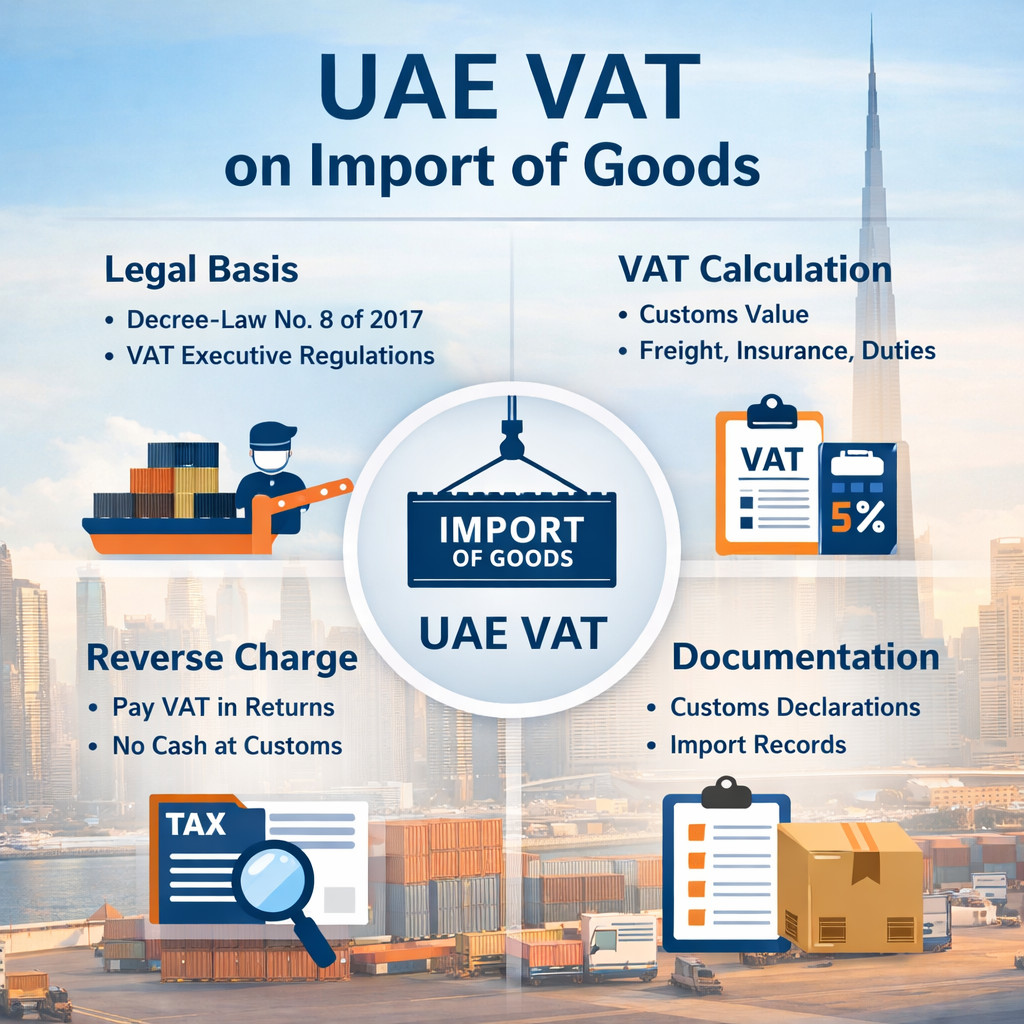
UAE VAT on Import of Goods from Implementing States – Complete Legal & Practical Guide
Importing goods into the UAE is a common commercial activity—but it also triggers important Value Added Tax (VAT) obligations. Businesses frequently ask:
Does VAT apply when importing goods from implementing states?
Which laws govern this?
How is VAT calculated and reported?
This article provides a comprehensive explanation of UAE VAT treatment on imports, with legal references, valuation rules, and compliance guidance for businesses.
What Does “Import of Goods” Mean for UAE VAT Purposes?
Under UAE VAT legislation, the import of goods occurs when goods are brought into the UAE from outside its VAT territory and cleared through customs.
VAT is generally payable at the time of importation, unless special mechanisms apply.
Legal Framework Governing VAT on Imports in the UAE
VAT on imports is governed primarily by:
Federal Decree-Law No. 8 of 2017 on VAT
This law establishes:
-
VAT on taxable supplies and imports
-
The standard rate of 5%
-
How the value of imported goods is determined
VAT Executive Regulations (Cabinet Decision No. 52 of 2017, as amended)
These regulations explain:
-
When goods are treated as imported
-
Customs suspension arrangements
-
Accounting for VAT by registered importers
-
Documentation requirements
How Is VAT Calculated on Imported Goods?
Taxable Value of Imports
VAT is not calculated only on the invoice price.
The taxable value generally includes:
-
Purchase price of goods
-
Freight charges
-
Insurance costs
-
Customs duties or excise tax
Formula:
VAT Base = Customs Value + Freight + Insurance + Duties
VAT at 5% is then applied to this total.
Example Calculation
| Item | Amount (AED) |
|---|---|
| Cost of goods | 100,000 |
| Freight & insurance | 5,000 |
| Customs duty | 10,000 |
| VAT Base | 115,000 |
| VAT @ 5% | 5,750 |
VAT Accounting for Registered Importers
VAT-registered businesses in the UAE can often use a reverse charge mechanism through the FTA portal:
-
VAT is declared in the VAT return
-
No cash payment at customs (subject to conditions)
-
Input VAT can usually be recovered, if goods are used for taxable supplies
This is critical for cash-flow management.
Imports Through Agents
Where goods are imported by an agent on behalf of a VAT-registered business:
-
The principal may still account for VAT
-
Conditions must be satisfied
-
Proper customs and contractual documentation is required
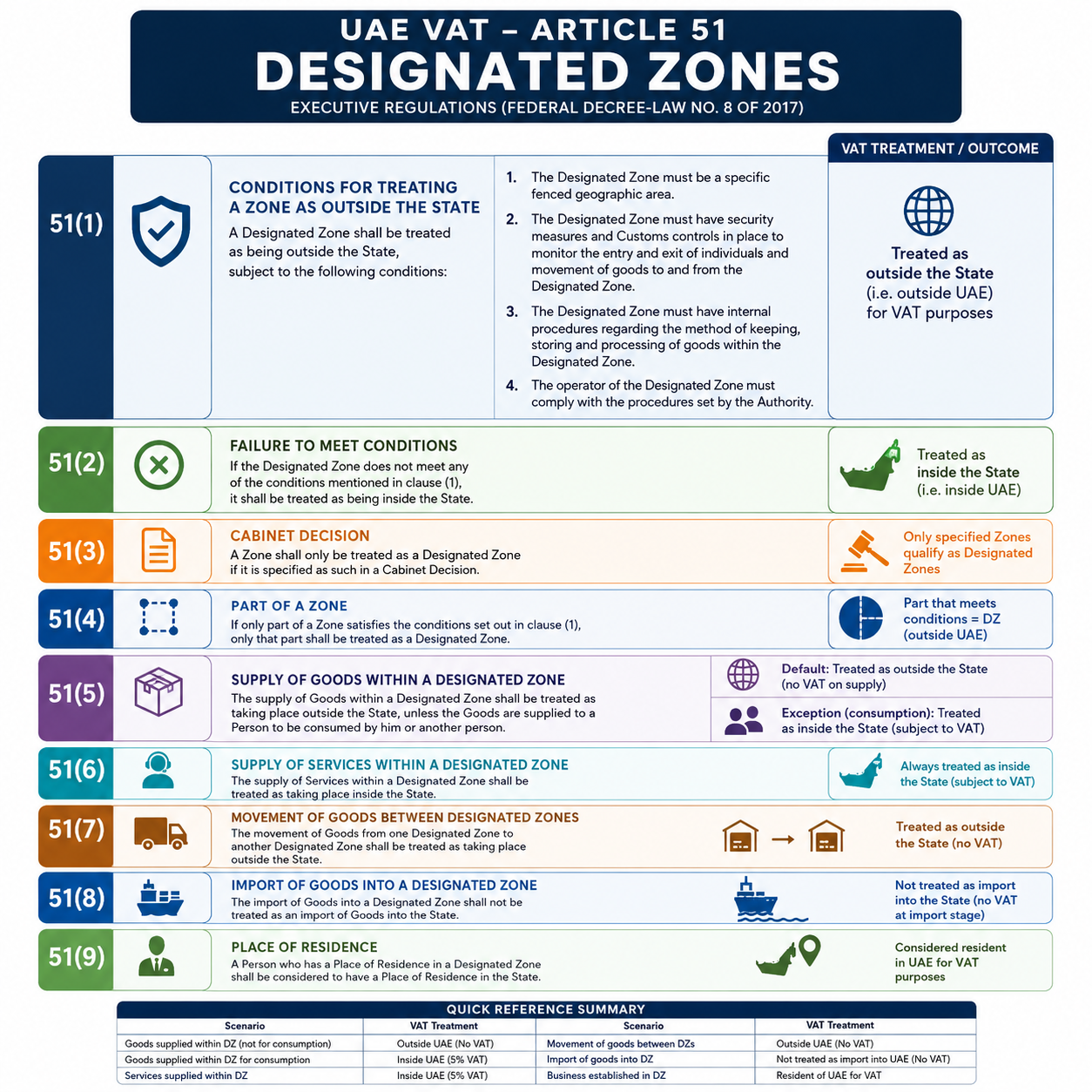
Designated Zones and Customs Suspension
Certain imports:
-
Entering Designated Zones
-
Under customs suspension
-
Intended for re-export
may not immediately trigger VAT—but VAT becomes due once goods are released into the UAE mainland.
What Are “Implementing States”?
Historically, the term Implementing States refers to GCC countries that adopted a unified VAT framework.
However, for UAE VAT purposes today:
-
Goods entering the UAE from any foreign jurisdiction are generally treated as imports
-
VAT rules apply at customs regardless of whether the country is within the GCC or outside it
Compliance Requirements for Businesses
To remain compliant, businesses importing goods must ensure:
Documentation Is Complete
-
Customs declarations
-
Commercial invoices
-
Bill of lading / airway bill
-
Import VAT statements
-
FTA portal filings
VAT Returns Are Accurate
-
Import VAT declared correctly
-
Reverse charge entries made where applicable
-
Input VAT recovery claimed only when allowed
Common Mistakes to Avoid
❌ Under-declaring freight or duty in VAT base
❌ Missing import VAT in VAT returns
❌ Poor record keeping
❌ Incorrect agent arrangements
❌ Assuming Designated Zone imports are always VAT-free
Why Proper VAT Treatment Matters
Incorrect VAT handling can result in:
-
Administrative penalties
-
Late payment fines
-
Input VAT disallowance
-
FTA audits
Strong compliance protects both cash flow and regulatory standing.
How We Can Help
We assist businesses with:
-
Import VAT structuring
-
FTA registrations
-
VAT return filing
-
Audit support
-
Customs-VAT reconciliations
-
Advisory on Designated Zones and reverse charge rules
If your company imports goods into the UAE, professional VAT planning can significantly reduce risk.
What's Your Reaction?
 Like
0
 Dislike
0
 Love
0
 Funny
0
 Wow
0
 Sad
0
 Angry
0









Comments (0)