
TAXP010 - Free Zones and Designated Zones for UAE Tax Purposes
FTA TAXP010, issued on 2 October 2026, explains the treatment of Free Zones and Designated Zones for UAE tax purposes. Learn the key differences for Corporate Tax, VAT and Excise Tax.

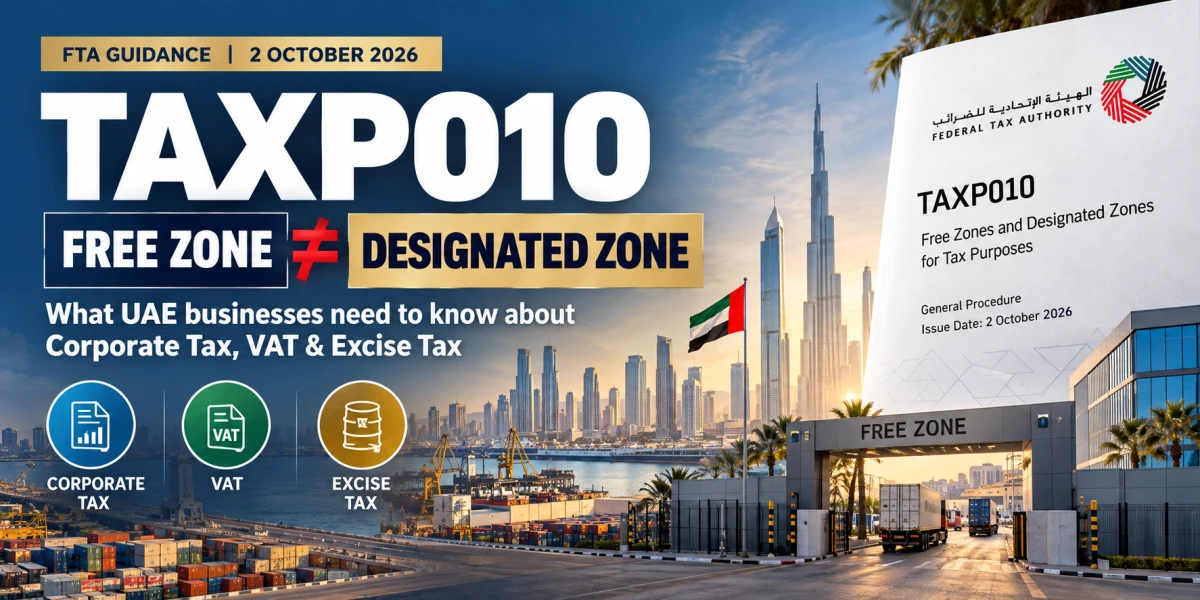
TAXP010: Free Zones and Designated Zones for UAE Tax Purposes
Is every UAE Free Zone a Designated Zone?
No. The terms Free Zone and Designated Zone have specific meanings under UAE tax legislation, and their treatment can differ depending on the tax being considered.
This distinction is the focus of the Federal Tax Authority's new TAXP010 – Free Zones and Designated Zones for Tax Purposes, issued on 2 October 2026.
TAXP010 is classified by the FTA as a General Procedure and is listed within the FTA's guidance resources for Corporate Tax, VAT and Excise Tax.
For UAE businesses, the practical message is simple:
A Free Zone licence should not, by itself, be treated as proof of a particular tax treatment.
What is TAXP010?
TAXP010 is the Federal Tax Authority publication titled “Free Zones and Designated Zones for Tax Purposes.”
The publication was issued on 2 October 2026 and provides guidance on the concepts of Free Zones and Designated Zones for UAE tax purposes.
The guidance is particularly relevant because the terminology is used across different UAE tax regimes, including:
- UAE Corporate Tax
- UAE Value Added Tax (VAT)
- UAE Excise Tax
However, businesses should not assume that the definition or tax consequence applicable under one tax law automatically applies under another.
Key takeaway: Always identify the applicable tax law before determining whether a location qualifies as a Free Zone or Designated Zone for the purpose being analysed.
Free Zone vs Designated Zone: What Is the Difference?
The words may sound similar, but they should not be used interchangeably in UAE tax analysis.
A Free Zone is a defined concept under the UAE Corporate Tax framework, while a Designated Zone has specific relevance under the VAT framework and is also relevant to certain Corporate Tax rules.
Excise Tax has its own Designated Zone framework and compliance requirements.
Therefore, the correct question is not simply:
“Is this company located in a Free Zone?”
The better question is:
“What is the status of this location under the specific UAE tax law relevant to this transaction?”
Is Every Free Zone a Designated Zone for VAT?
No.
For UAE VAT purposes, a Free Zone is not automatically treated as a Designated Zone.
The FTA's VAT guidance explains that Free Zones are generally within the UAE VAT territorial scope unless they meet the requirements applicable to a Designated Zone.
For VAT purposes, Designated Zones are specified under the relevant Cabinet Decisions and must satisfy the applicable conditions.
These conditions include requirements concerning matters such as:
- A clearly defined geographical area;
- Security and control over access;
- Customs controls over the movement of goods;
- Procedures for keeping, storing and processing goods; and
- Compliance with the applicable FTA requirements.
Therefore:
Free Zone ≠ Automatically VAT Designated Zone
This distinction is particularly important when determining the VAT treatment of supplies and movements of goods.
How Does a VAT Designated Zone Affect VAT?
A VAT Designated Zone is treated as being outside the UAE for VAT purposes for specific supplies of goods, subject to the applicable conditions.
This does not mean that everything occurring within a Designated Zone is outside the scope of UAE VAT.
In particular, the VAT treatment of services remains subject to the normal UAE VAT rules.
Businesses operating in Designated Zones should therefore analyse each transaction rather than applying a blanket “VAT-free” assumption.
This is especially relevant for:
- Import and export transactions;
- Goods stored in a Designated Zone;
- Goods moved between Designated Zones;
- Goods supplied to mainland customers;
- Goods removed from a Designated Zone into the UAE mainland; and
- Services supplied to businesses operating in a Designated Zone.
How Does TAXP010 Relate to UAE Corporate Tax?
The Free Zone concept is also important under the UAE Corporate Tax regime.
A company established or operating in a Free Zone may potentially qualify as a Qualifying Free Zone Person (QFZP), subject to meeting the conditions prescribed under the Corporate Tax Law and related decisions.
A QFZP may benefit from the 0% Corporate Tax rate on Qualifying Income, while the applicable Corporate Tax rules continue to apply to income that does not qualify for the 0% treatment.
Accordingly, the following statement is too broad:
“Our company is in a Free Zone, so our Corporate Tax rate is 0%.”
The proper Corporate Tax analysis requires consideration of the applicable QFZP conditions and the nature of the income earned by the business.
Does a Free Zone Licence Automatically Make a Company a QFZP?
No.
A Free Zone company and a Qualifying Free Zone Person are not automatically the same thing.
QFZP treatment is subject to specific statutory conditions.
Depending on the circumstances, the analysis can involve matters such as:
- Free Zone Person status;
- Qualifying Income;
- Qualifying Activities;
- Excluded Activities;
- Adequate substance;
- Compliance with the applicable transfer pricing requirements;
- De minimis requirements;
- Audited financial statements; and
- Other conditions prescribed under the UAE Corporate Tax framework.
Therefore, holding a Free Zone licence is only one part of the overall Corporate Tax analysis.
Why Is “Designated Zone” Relevant to Corporate Tax?
This is where the terminology becomes particularly important.
Under the UAE Corporate Tax framework, the concept of a Designated Zone is relevant to specific aspects of the QFZP rules, including the treatment of certain distribution activities.
Accordingly, a business involved in the distribution of goods or materials should not rely solely on the fact that it holds a Free Zone licence.
The business should establish whether the relevant location satisfies the applicable requirements for the particular Corporate Tax analysis.
This is especially important for businesses whose operating model involves:
- Wholesale distribution;
- Trading of goods;
- Import and re-export;
- Warehousing;
- Regional distribution;
- Distribution to mainland customers; or
- Movement of goods through UAE ports and zones.
What About Excise Tax Designated Zones?
The concept of a Designated Zone also exists under the UAE Excise Tax framework.
For Excise Tax purposes, Designated Zones have specific requirements concerning the control and movement of excise goods.
The FTA's Excise Tax guidance refers to Designated Zones, including areas subject to customs, security and warehouse-keeper controls.
This demonstrates another important principle:
The same words do not necessarily produce the same tax consequences under every UAE tax law.
Why Businesses Should Review Their Free Zone Tax Position
The practical risk usually begins with a simple assumption:
“We have a Free Zone licence, therefore the transaction receives Free Zone tax treatment.”
That approach can be incomplete.
A proper tax review should establish five things:
- Where is the business located?
- Which tax law is being applied?
- What is the status of the location under that tax law?
- What activity or transaction is taking place?
- What conditions and documentation support the tax treatment?
In practical terms:
Location → Tax Law → Zone Status → Activity → Transaction → Tax Treatment
Free Zone Tax Analysis: A Practical Checklist
Businesses operating in UAE Free Zones should consider maintaining a documented analysis covering the following:
| Area | Key Question |
|---|---|
| Location | What is the exact physical location of the business? |
| Free Zone Status | Does the location meet the relevant Corporate Tax requirements? |
| VAT Designated Zone | Is the location recognised as a VAT Designated Zone? |
| Excise Tax | Does the business or warehouse have relevant Designated Zone requirements? |
| Business Activity | Is the business providing services, trading goods, manufacturing or distributing goods? |
| QFZP | Does the entity satisfy the conditions to be a Qualifying Free Zone Person? |
| Transactions | Are transactions with mainland, Free Zone, Designated Zone or overseas customers involved? |
| Documentation | Can the business substantiate its tax treatment with appropriate records? |
Common Mistakes to Avoid
1. Assuming Every Free Zone Is a VAT Designated Zone
A Free Zone licence does not automatically establish VAT Designated Zone status.
2. Assuming Free Zone Means 0% Corporate Tax
QFZP treatment is conditional. The entity must satisfy the applicable requirements.
3. Applying VAT Rules to Corporate Tax Without Checking the Law
The terminology may overlap, but the legal tests and consequences must be analysed under the relevant legislation.
4. Treating All Transactions in a Designated Zone as VAT-Free
The special VAT treatment is primarily relevant to specified supplies of goods and is subject to conditions. Services require separate analysis.
5. Ignoring the Physical Movement of Goods
For trading, distribution and logistics businesses, the movement of goods can be critical to determining the correct tax treatment.
Frequently Asked Questions About TAXP010
What is TAXP010?
TAXP010 is the Federal Tax Authority's General Procedure publication titled “Free Zones and Designated Zones for Tax Purposes.” It was issued on 2 October 2026.
Is every UAE Free Zone a Designated Zone?
No. Free Zone and Designated Zone are distinct tax concepts. The relevant status must be determined under the applicable UAE tax legislation.
Is a Free Zone company automatically a QFZP?
No. A Free Zone Person must satisfy the applicable conditions to qualify as a Qualifying Free Zone Person.
Does a VAT Designated Zone mean that all supplies are outside UAE VAT?
No. The special VAT treatment applies subject to specific conditions and is particularly relevant to certain supplies of goods. Services require separate VAT analysis.
Why is TAXP010 important for UAE businesses?
TAXP010 is important because businesses may use the terms Free Zone and Designated Zone interchangeably even though the tax treatment depends on the applicable tax law, location, activity and transaction.
Which businesses should pay particular attention to TAXP010?
Free Zone companies, QFZPs, distributors, trading companies, importers, exporters, manufacturers, warehouse operators and businesses involved in cross-border movement of goods should review the guidance carefully.
Key Takeaway
The biggest lesson from TAXP010 is simple:
Do not start your tax analysis with the licence.
Start with the:
Location + Tax Law + Zone Status + Activity + Transaction
Only then should the business determine the applicable UAE tax treatment.
Free Zone does not automatically mean Designated Zone.
Free Zone does not automatically mean 0% Corporate Tax.
Designated Zone does not mean every transaction is outside VAT.
These distinctions are exactly why TAXP010 is important for UAE businesses and tax professionals.
Official FTA Reference
Federal Tax Authority (FTA)
TAXP010 – Free Zones and Designated Zones for Tax Purposes
Issue Date: 2 October 2026
Category: General Procedure
Read TAXP010 on the Federal Tax Authority website
Professional Review for UAE Free Zone Businesses
If your company operates from a UAE Free Zone, the correct tax treatment should be assessed based on the specific location, applicable tax regime, business activity and transaction structure.
A structured review can help identify whether the business has correctly considered its Corporate Tax, QFZP, VAT and Designated Zone obligations.
Do not assume. Verify the zone. Analyse the transaction. Document the position.
What's Your Reaction?
 Like
0
 Dislike
0
 Love
0
 Funny
0
 Wow
0
 Sad
0
 Angry
0
Comments (0)