
UAE Corporate Tax Update: Are Audits Mandatory for Free Zone Companies?
Learn whether audits are mandatory for UAE Free Zone companies under Corporate Tax. Understand the rules for Qualifying Free Zone Persons (QFZP), audit requirements from 2025, and compliance obligations under UAE law.

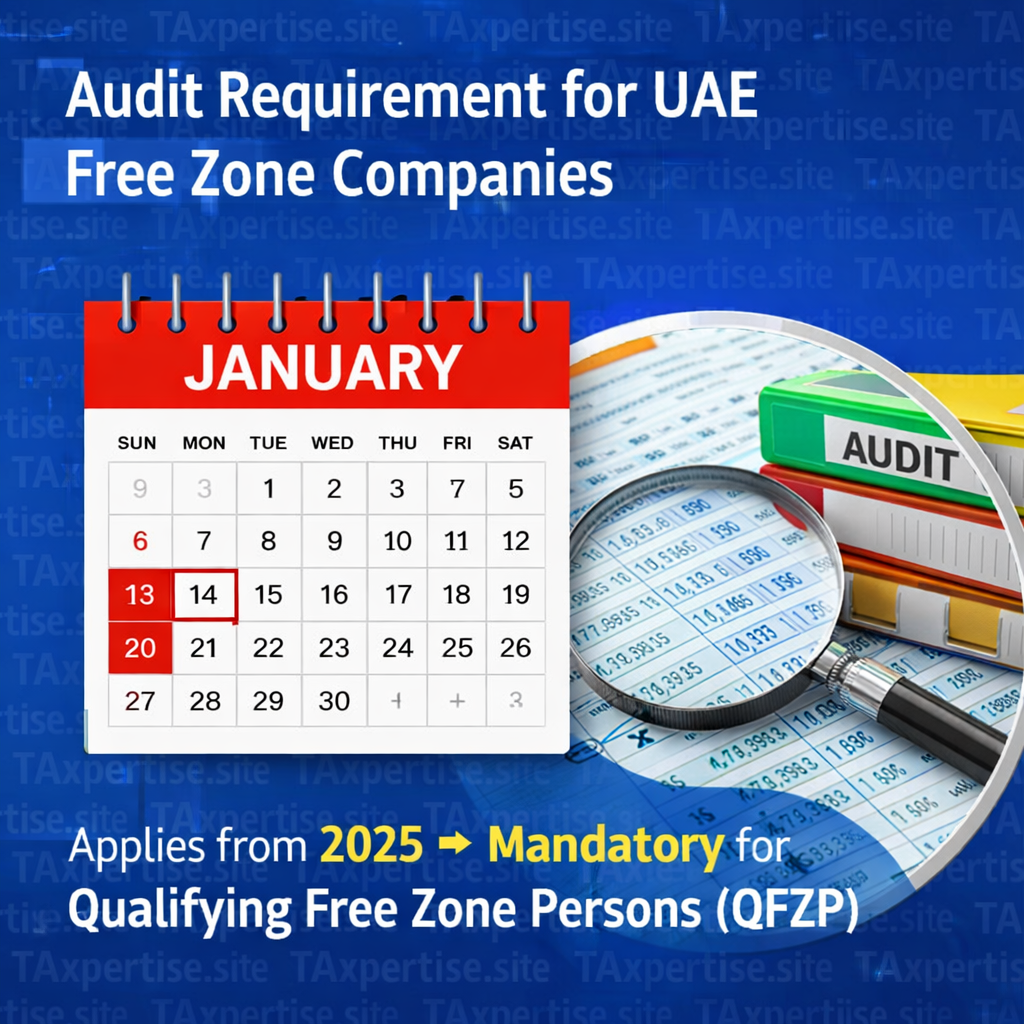
UAE Corporate Tax Update: Are Audits Mandatory for Free Zone Companies?
With the implementation of UAE Corporate Tax, many businesses operating in Free Zones are asking an important question: Will audits become mandatory for Free Zone companies?
The short answer is: Yes, in certain cases audits are mandatory. However, the requirement depends on whether the company qualifies for the 0% Corporate Tax regime or falls under the normal 9% Corporate Tax rate.
This article explains the official requirements, legal basis, and which Free Zone companies must maintain audited financial statements.
Legal Source of the Audit Requirement
The audit requirement arises from the UAE Corporate Tax framework and related ministerial decisions issued by the Ministry of Finance and the Federal Tax Authority (FTA).
Under these rules, certain businesses must maintain audited financial statements to support their Corporate Tax position.
When Are Audited Financial Statements Required?
Audited financial statements are mandatory in the following situations:
- Qualifying Free Zone Persons (QFZP) claiming the 0% Corporate Tax benefit.
- Any taxable person generating annual revenue exceeding AED 50 million.
- Entities required to maintain audited accounts under other regulatory authorities.
Audit Requirement for Qualifying Free Zone Persons (QFZP)
Companies operating in UAE Free Zones can benefit from a 0% Corporate Tax rate if they meet the criteria of a Qualifying Free Zone Person.
However, to maintain this tax advantage, the company must:
- Maintain proper accounting records
- Prepare financial statements in accordance with accounting standards
- Ensure the financial statements are audited by an independent auditor
These audited financial statements help verify compliance with important Corporate Tax rules such as:
- Qualifying income requirements
- De minimis rule compliance
- Related party transactions
- Transfer pricing documentation
When Does the Audit Requirement Apply?
The requirement applies to tax periods beginning on or after 1 January 2025.
This means businesses preparing their financial statements for the 2025 financial year must ensure their records comply with Corporate Tax audit requirements.
Important Clarification for Free Zone Companies
Many business owners believe that all Free Zone companies must conduct an audit. This is not entirely correct.
The audit requirement mainly applies to companies that:
- Claim the 0% Corporate Tax regime
- Have revenue exceeding AED 50 million
- Are required by their Free Zone authority to maintain audited accounts
Companies paying the standard 9% Corporate Tax rate may not necessarily need audited financial statements unless they meet the revenue threshold or regulatory requirements.
Why This Matters for Free Zone Businesses
Failure to maintain proper financial records or audited statements may lead to:
- Loss of 0% Corporate Tax eligibility
- Reclassification under the 9% Corporate Tax regime
- Additional compliance risks during tax reviews
Therefore, Free Zone companies should review their accounting systems early and ensure they are prepared for Corporate Tax compliance.
Final Thoughts
The introduction of Corporate Tax in the UAE has significantly increased the importance of financial transparency and proper accounting practices.
Free Zone businesses aiming to benefit from the 0% Corporate Tax rate must ensure they maintain accurate accounting records and audited financial statements to support their tax position.
Understanding these requirements early will help businesses avoid compliance issues and maintain their valuable Free Zone tax benefits.
What's Your Reaction?
 Like
0
 Dislike
0
 Love
0
 Funny
0
 Wow
0
 Sad
0
 Angry
0







Comments (0)