
UAE Mainland vs Free Zone vs Designated Zone – Complete Tax Guide
Learn the key differences between UAE Mainland, Free Zone, and Designated Zone businesses and their VAT and Corporate Tax implications. Understand how transactions between Free Zones and Designated Zones are treated under UAE tax law.

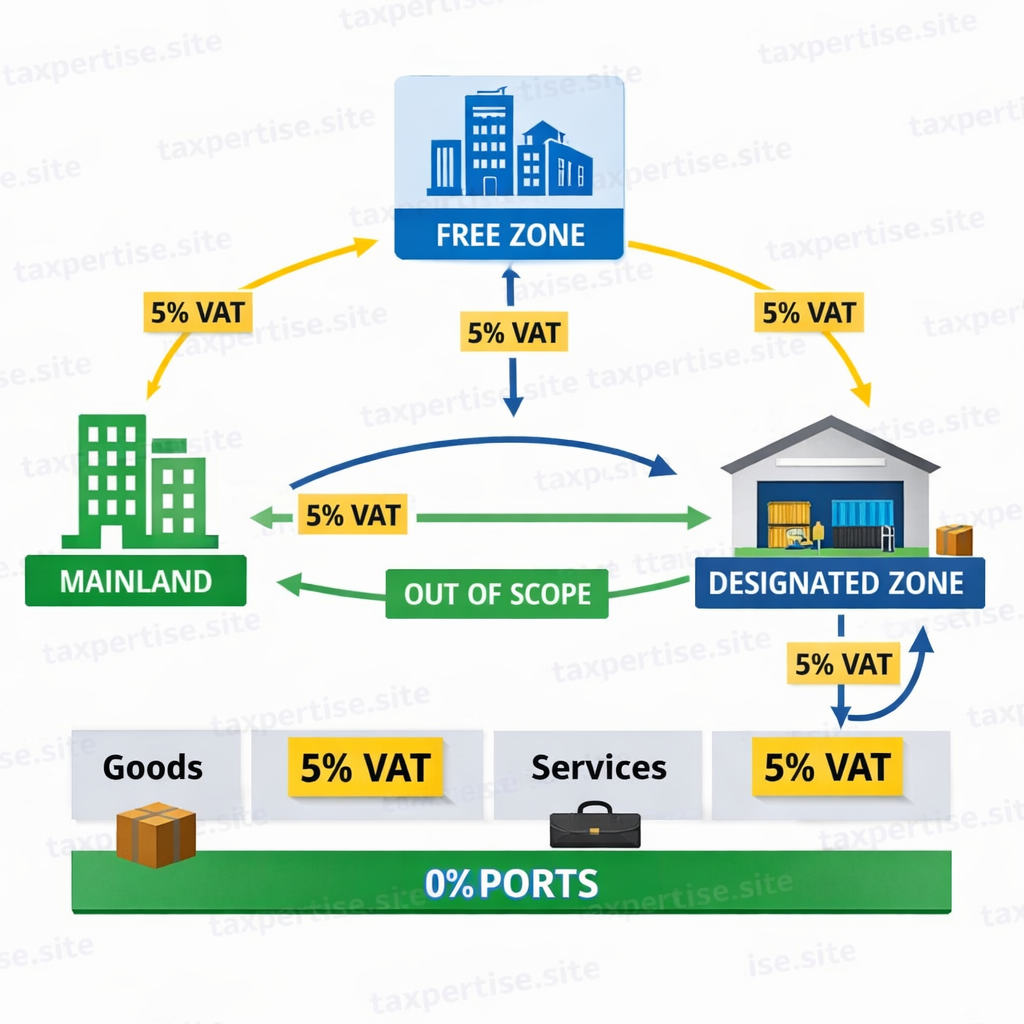
Mainland vs Free Zone vs Designated Zone in UAE – VAT and Corporate Tax Implications
When setting up or operating a business in the UAE, understanding the difference between Mainland, Free Zone, and Designated Zone entities is essential. Each jurisdiction has different tax implications under UAE VAT and Corporate Tax laws.
Incorrect assumptions about tax treatment — especially between Free Zones and Designated Zones — can lead to significant VAT compliance risks. Many businesses wrongly assume that all Free Zone transactions are tax-free, which is not correct.
This guide explains how these jurisdictions differ and how VAT and Corporate Tax apply to transactions between them. For official tax legislation and updates, visit the Federal Tax Authority (FTA).
1. Mainland Companies in the UAE
A Mainland company is licensed by the Department of Economic Development (DED) of an Emirate and is permitted to operate anywhere within the UAE without restrictions.
Corporate Tax Treatment
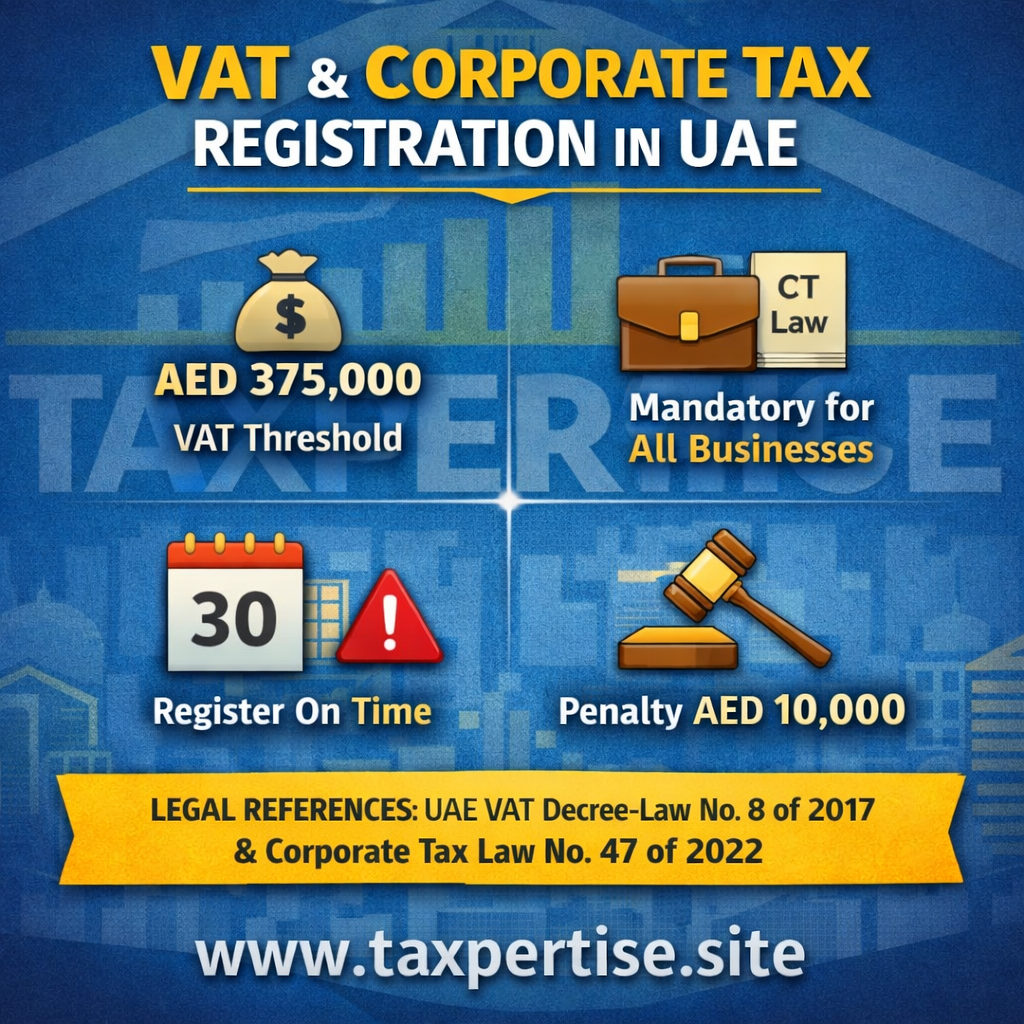
- Corporate Tax rate of 9% on taxable income exceeding AED 375,000.
- Income below AED 375,000 is subject to 0% Corporate Tax.
VAT Treatment
- Standard VAT rate of 5% applies to most goods and services.
- Businesses must register for VAT once taxable supplies exceed AED 375,000.
- Input VAT recovery is allowed subject to UAE VAT recovery rules.
2. Free Zone Companies
A Free Zone company is established within a UAE Free Zone authority such as IFZA, DMCC, or DIFC. These zones offer simplified business regulations and tax incentives for foreign investors.
Corporate Tax Treatment
Free Zone companies may qualify as a Qualifying Free Zone Person (QFZP) and benefit from a 0% Corporate Tax rate on qualifying income.
- 0% Corporate Tax on qualifying income.
- 9% Corporate Tax on non-qualifying income.
- Must maintain adequate economic substance.
- Must prepare audited financial statements.
VAT Treatment
For VAT purposes, Free Zones are treated the same as Mainland UAE unless the Free Zone is classified as a Designated Zone.
- Supplies of goods and services are generally subject to 5% VAT.
- Supplies between Free Zone companies are normally taxable at 5% VAT.
- Exports outside the UAE may qualify for 0% VAT if conditions are met.
- Input VAT recovery is allowed subject to normal VAT recovery rules.
3. Designated Zones
A Designated Zone is a specific Free Zone area that is treated as outside the UAE for VAT purposes for goods transactions, subject to strict conditions.
These zones are typically used for logistics, manufacturing, and warehousing.
Key VAT Rule
Designated Zone treatment applies primarily to goods. Services supplied within Designated Zones remain subject to VAT.
VAT Treatment of Transactions Between Free Zones and Designated Zones
1. Free Zone → Free Zone
- Goods supply: 5% VAT applies
- Services supply: 5% VAT applies
Because both locations are treated as part of the UAE for VAT purposes.
2. Designated Zone → Designated Zone
- Goods transfer: Out of Scope of VAT
- Services: 5% VAT applies
The movement of goods between Designated Zones may be treated as outside the scope of VAT if regulatory conditions are met.
3. Free Zone → Designated Zone
- Goods: 5% VAT
- Services: 5% VAT
Because the supply originates from a Free Zone that is treated as part of the UAE for VAT purposes.
4. Designated Zone → Free Zone
- Goods: 5% VAT
- Services: 5% VAT
Once goods move from a Designated Zone into a normal Free Zone, they are treated as entering the UAE VAT territory.
Comparison Table – Mainland vs Free Zone vs Designated Zone
| Feature | Mainland | Free Zone | Designated Zone |
|---|---|---|---|
| Corporate Tax | 9% | 0% or 9% | Same as Free Zone |
| VAT on Services | 5% | 5% | 5% |
| Goods Transfer between Zones | 5% | 5% | May be Out of Scope |
| Typical Activities | Local trade and services | International business | Warehousing and logistics |
Common Misconception
A frequent misunderstanding among businesses is that all Free Zone transactions are VAT exempt.
In reality:
- Most Free Zone transactions are subject to 5% VAT.
- Only Designated Zones provide special VAT treatment.
- Even in Designated Zones, the benefit mainly applies to goods transactions.
Legal Basis Under UAE VAT Law
The VAT treatment of Free Zones and Designated Zones is governed by the UAE VAT Executive Regulations. In particular, Article 51 of the Executive Regulations provides the framework for the treatment of Designated Zones.
Under these regulations:
- A Designated Zone may be treated as outside the UAE for VAT purposes for specific goods transactions.
- This treatment applies only when strict conditions are satisfied, including customs supervision and controlled movement of goods.
- Services supplied within Designated Zones remain subject to VAT under normal UAE VAT rules.
- Free Zones that are not classified as Designated Zones are treated as part of the UAE for VAT purposes.
Businesses should always verify the official list of Designated Zones issued by the Federal Tax Authority (FTA).
Professional Tax Advisory in UAE
Choosing the correct business structure can significantly impact your VAT exposure, Corporate Tax liability, and compliance obligations.
Taxpertise provides professional advisory services including:
- Corporate Tax advisory
- Free Zone tax planning
- QFZP eligibility assessments
- VAT structuring
- VAT and Corporate Tax compliance
Practical VAT Scenarios for Free Zone and Designated Zone Businesses
The table below illustrates common VAT scenarios faced by businesses operating across Mainland UAE, Free Zones, and Designated Zones.
| Scenario | Transaction Type | VAT Treatment |
|---|---|---|
| IFZA company selling consulting services to DMCC company | Free Zone → Free Zone | 5% VAT |
| DMCC company selling goods to Mainland Dubai business | Free Zone → Mainland | 5% VAT |
| JAFZA warehouse transferring goods to Hamriyah Free Zone warehouse | Designated Zone → Designated Zone | Out of Scope of VAT |
| Designated Zone supplier selling goods to Free Zone company | Designated Zone → Free Zone | 5% VAT |
| Free Zone company supplying goods to Designated Zone company | Free Zone → Designated Zone | 5% VAT |
| Free Zone consulting firm providing services to UK client | Export of services | 0% VAT (subject to conditions) |
| Designated Zone logistics company providing services within the zone | Service within Designated Zone | 5% VAT |
VAT Logic for Free Zone and Designated Zone Transactions
The following simplified logic helps determine VAT treatment for transactions involving Free Zones and Designated Zones:
- Mainland → Mainland = 5% VAT
- Free Zone → Free Zone = 5% VAT
- Free Zone → Mainland = 5% VAT
- Designated Zone → Designated Zone (Goods) = Out of Scope
- Designated Zone → Mainland = 5% VAT
- Designated Zone → Free Zone = 5% VAT
- Services in any zone = 5% VAT unless zero-rated under export rules
Examples of UAE Designated Zones
Some of the most commonly used Designated Zones in the UAE include:
- Jebel Ali Free Zone (JAFZA)
- Dubai Airport Free Zone
- Sharjah Hamriyah Free Zone
- Khalifa Port Free Zone – Abu Dhabi
- Abu Dhabi Airport Free Zone
- Sharjah Airport International Free Zone (SAIF Zone)
The official and updated list of Designated Zones is issued by the Federal Tax Authority (FTA).
Common VAT Compliance Risks for Free Zone Businesses
- Assuming all Free Zone transactions are VAT exempt.
- Incorrectly treating Free Zone to Free Zone supplies as out of scope.
- Misinterpreting Designated Zone rules for services.
- Failure to apply VAT when goods enter the UAE mainland market.
- Improper documentation of export supplies.
Incorrect VAT treatment can lead to significant penalties during FTA audits.
Evaluate Your Tax Compliance Risk
UAE tax regulations can be complex, particularly when dealing with VAT structuring, Free Zone transactions, Corporate Tax classification, and Designated Zone rules. Incorrect interpretation of these regulations may expose businesses to penalties, assessments, or compliance risks during Federal Tax Authority (FTA) audits.
If your business operates across Mainland, Free Zones, or Designated Zones, it is advisable to conduct a professional review to ensure that your tax treatment aligns with the latest UAE tax regulations.
Taxpertise assists businesses with:
- VAT compliance risk assessment
- Corporate Tax exposure evaluation
- Free Zone tax structuring
- QFZP eligibility review
- FTA audit preparedness
If you would like to evaluate the tax compliance risk of your business, you may connect with our advisory team for a professional assessment.
Email: zubairfaiziuae@gmail.com
Contact: +971555836797
What's Your Reaction?
 Like
0
 Dislike
0
 Love
0
 Funny
0
 Wow
0
 Sad
0
 Angry
0




Comments (0)