
OECD BEPS Pillar One and Pillar Two Explained Under UAE Tax Law
A comprehensive UAE-focused explanation of OECD BEPS Pillar One and Pillar Two, including global minimum tax, UAE Domestic Minimum Top-Up Tax (DMTT), applicability thresholds, and practical implications under UAE Corporate Tax Law.

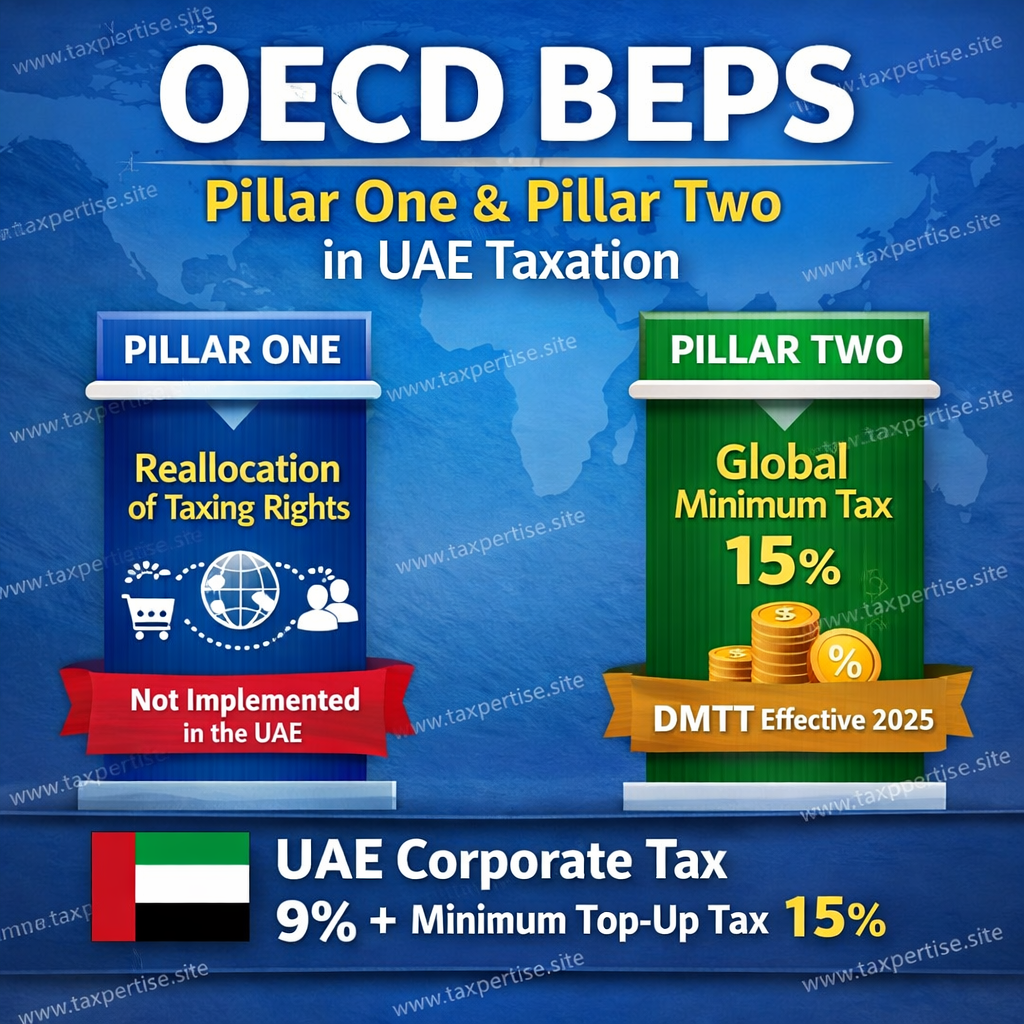
OECD BEPS Pillar One and Pillar Two Explained Under UAE Taxation
The OECD Base Erosion and Profit Shifting (BEPS) 2.0 framework represents a fundamental shift in global taxation, designed to ensure that multinational enterprises (MNEs) pay a fair level of tax in jurisdictions where economic activities and value creation occur. As a member of the OECD Inclusive Framework, the United Arab Emirates (UAE) has aligned its tax system with these global reforms while maintaining its competitive business environment.
Understanding BEPS 2.0
The BEPS 2.0 project consists of two main pillars:
- Pillar One – Reallocation of taxing rights to market jurisdictions
- Pillar Two – Introduction of a global minimum corporate tax rate
These pillars are intended to address challenges arising from digitalization and profit shifting to low-tax jurisdictions.
Pillar One – Reallocation of Taxing Rights
OECD Concept
Under Pillar One, a portion of residual profits of the largest and most profitable MNEs is reallocated to jurisdictions where customers or users are located, even if the group has no physical presence there. This pillar primarily targets highly digitalized and consumer-facing businesses.
Position Under UAE Tax Law
As of today, Pillar One has not been implemented into UAE domestic tax legislation. The UAE Corporate Tax Law does not contain provisions that reallocate profits based on user or customer location. Therefore, for UAE tax purposes, Pillar One remains an international policy initiative rather than an enforceable local tax rule.
UAE taxable profits continue to be determined based on:
- Tax residency
- Permanent establishment principles
- Transfer pricing rules aligned with OECD standards
Pillar Two – Global Minimum Tax (GloBE Rules)
OECD Framework
Pillar Two introduces a global minimum effective tax rate of 15% for large multinational groups. It applies to MNEs with consolidated global revenues of at least EUR 750 million in at least two of the previous four financial years.
The framework operates through:
- Income Inclusion Rule (IIR)
- Undertaxed Profits Rule (UTPR)
- Domestic Minimum Top-Up Tax (DMTT)
Implementation of Pillar Two in the UAE
Domestic Minimum Top-Up Tax (DMTT)
The UAE has formally adopted Pillar Two through the introduction of a Domestic Minimum Top-Up Tax (DMTT), effective for financial years starting on or after 1 January 2025.
Under the DMTT:
- Qualifying UAE entities of large MNE groups must pay a minimum effective tax rate of 15%
- If the effective tax rate in the UAE falls below 15%, a top-up tax will be applied locally
- This ensures taxing rights remain with the UAE rather than being collected by foreign jurisdictions
Interaction with UAE Corporate Tax
Under Federal Decree-Law No. 47 of 2022, the UAE levies a 9% corporate tax on taxable income exceeding AED 375,000. For in-scope MNEs, the DMTT operates in addition to UAE corporate tax to bridge the gap up to the 15% minimum threshold.
Official guidance and legislative updates are issued by the Federal Tax Authority (FTA).
Who Is Affected in the UAE?
Not Affected
- Small and medium UAE businesses
- Groups with global revenues below EUR 750 million
- Purely domestic UAE groups with no multinational structure
Affected
- Large UAE-based multinational groups
- UAE subsidiaries of foreign multinational enterprises
- Free zone entities that form part of qualifying MNE groups
Key Practical Considerations for UAE Businesses
Businesses potentially in scope should:
- Assess global consolidated revenue thresholds
- Calculate jurisdictional effective tax rates
- Review accounting vs taxable profit differences
- Prepare for enhanced compliance and reporting obligations
Conclusion
In summary:
- Pillar One – Not yet implemented under UAE tax law
- Pillar Two – Fully adopted through the UAE Domestic Minimum Top-Up Tax effective from 2025
The UAE’s approach demonstrates its commitment to international tax transparency while preserving its status as a globally competitive business hub.
What's Your Reaction?
 Like
0
 Dislike
0
 Love
0
 Funny
0
 Wow
0
 Sad
0
 Angry
0












Comments (0)