
UAE VAT Bad Debt Relief: Conditions, Six-Month Rule and VAT Return Adjustments
Learn how UAE VAT bad debt relief works under FTA Public Clarification VATP024, including eligibility conditions, the six-month rule, customer notification and VAT return adjustments.

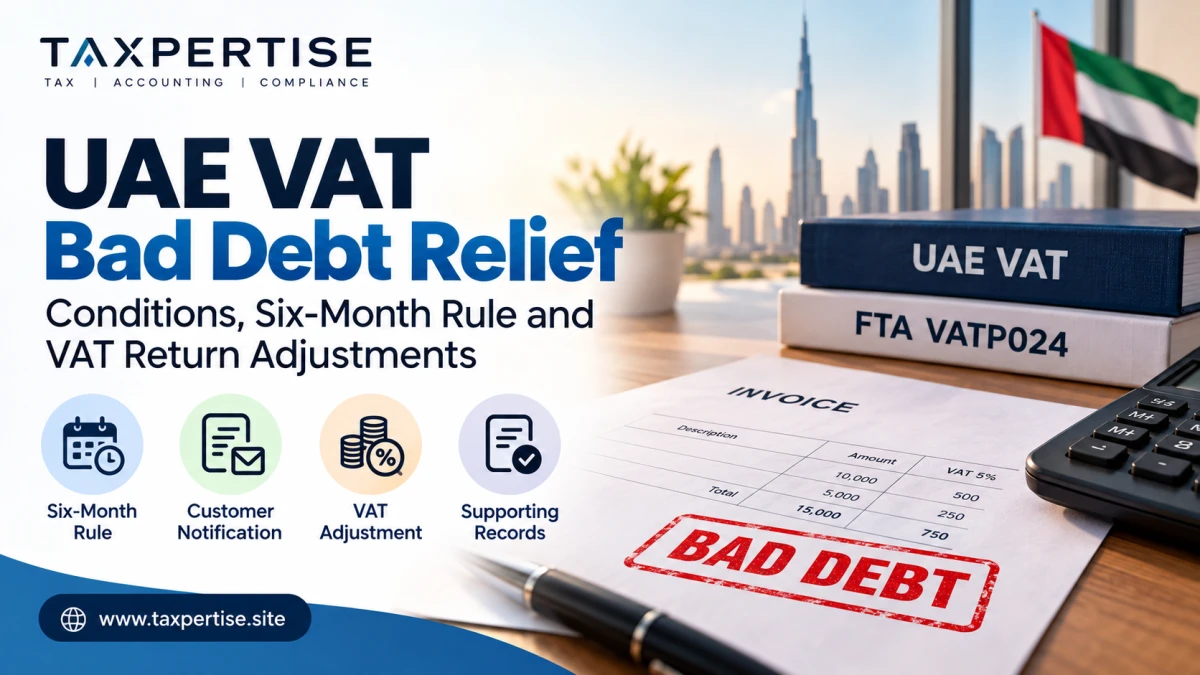
UAE VAT Bad Debt Relief: Conditions, Six-Month Rule and VAT Return Adjustments
When a customer fails to pay an invoice, a VAT-registered business may have already accounted for and paid output VAT to the Federal Tax Authority (FTA). UAE VAT legislation provides a mechanism for eligible suppliers to adjust output VAT relating to qualifying bad debts, subject to specific conditions.
FTA Public Clarification VATP024, Adjustment on Account of Bad Debt Relief, issued in March 2021, explains the requirements for claiming this relief under Article 64(1) of Federal Decree-Law No. 8 of 2017 on Value Added Tax.
What is bad debt relief under UAE VAT?
Bad debt relief allows a VAT-registered supplier to reduce output VAT previously accounted for on a supply where the customer has not paid the consideration and the statutory conditions are met. The adjustment is limited to the VAT attributable to the consideration actually written off as bad debt.
Four conditions for claiming UAE VAT bad debt relief
According to VATP024, all four conditions must be satisfied:
- VAT accounted for and paid: The supplier must have charged VAT on the supply and accounted for that VAT to the FTA through its VAT returns.
- Bad debt written off: The consideration must have been written off, wholly or partly, as a bad debt in the supplier’s accounts.
- More than six months elapsed: More than six months must have passed from the date of supply. During this period, the supplier should take steps to recover the outstanding debt.
- Customer notified: The supplier must notify the customer of the consideration written off, identifying at least the unpaid tax invoice number and date and the amount written off.
How does the six-month rule work?
The six-month period is measured from the date of supply, not automatically from the date an account is classified as doubtful. The supplier should pursue collection during this period and retain evidence of its recovery efforts.
How to calculate the VAT adjustment
The relief is limited to the VAT attributable to the amount written off. VATP024 provides the following example:
| Description | Full write-off | 50% write-off |
|---|---|---|
| Invoice total | AED 105 | AED 52.50 written off |
| Taxable value at 5% | AED 100 | AED 50 |
| VAT adjustment | AED 5 | AED 2.50 |
Where the entire AED 105 invoice is written off, the VAT adjustment is AED 5. Where only AED 52.50 is written off after collecting the remaining half, the VAT adjustment is AED 2.50.
Customer notification requirements
The FTA does not prescribe one exclusive notification method. A letter, email, post or similar communication may be used. The notification should identify the unpaid tax invoice number and date and the consideration written off.
The supplier does not need to obtain the customer's acknowledgement before making the adjustment. However, it must retain evidence of the notification and the steps taken to communicate the write-off.
Where should the adjustment be reported in the UAE VAT return?
VATP024 states that the bad debt relief adjustment should be reported in the “Adjustment” column of Box 1 of the VAT return. The adjustment must reflect the VAT amount only, not the gross invoice value, and should be reported for each Emirate where applicable, in accordance with the output VAT being adjusted.
Practical compliance checklist
- Confirm that the original supply was subject to VAT and the output VAT was accounted for and paid.
- Verify the date of supply and confirm that more than six months have elapsed.
- Ensure the relevant consideration has been written off in the accounting records as bad debt.
- Calculate the VAT attributable to the amount actually written off.
- Notify the customer and retain the notification evidence.
- Maintain supporting invoices, customer account reconciliations, collection correspondence and write-off approvals.
- Report the VAT-only adjustment in the Adjustment column of Box 1, allocated to the relevant Emirate where applicable.
Common mistakes to avoid
- Claiming relief before more than six months have passed from the date of supply.
- Adjusting VAT on a doubtful debt that has not been written off in the accounts.
- Claiming the full VAT amount when only part of the consideration has been written off.
- Failing to notify the customer or retain proof of notification.
- Reporting the gross bad debt amount instead of the VAT adjustment.
How TAXPERTISE can help
Bad debt relief requires coordination between accounts receivable, accounting write-offs and VAT return reporting. TAXPERTISE can assist businesses with VAT compliance reviews, bad debt adjustment assessments, supporting-document checks and VAT return reconciliation.
Need assistance reviewing an unpaid customer balance? Contact a UAE tax professional before making the adjustment to ensure that the applicable statutory conditions and documentation requirements have been addressed.
Official reference
FTA Public Clarification VATP024 – Adjustment on Account of Bad Debt Relief (March 2021)
This article summarises the cited FTA public clarification and is for general information only. The clarification does not replace the legislation or an assessment of the specific facts. Confirm the applicable legal provisions and current FTA guidance before filing.
What's Your Reaction?
 Like
0
 Dislike
0
 Love
0
 Funny
0
 Wow
0
 Sad
0
 Angry
0








Comments (0)