
UAE Ministerial Decision No. 64 of 2025 & 2026 Amendments: Complete Guide to Accredited Service Providers (ASP) for UAE E-Invoicing
Understand UAE Ministerial Decision No. 64 of 2025 and the 2026 amendments governing Accredited Service Providers (ASP) under the UAE Electronic Invoicing System. Learn eligibility criteria, accreditation procedures, compliance requirements, deadlines, and what UAE businesses should do before mandatory implementation.

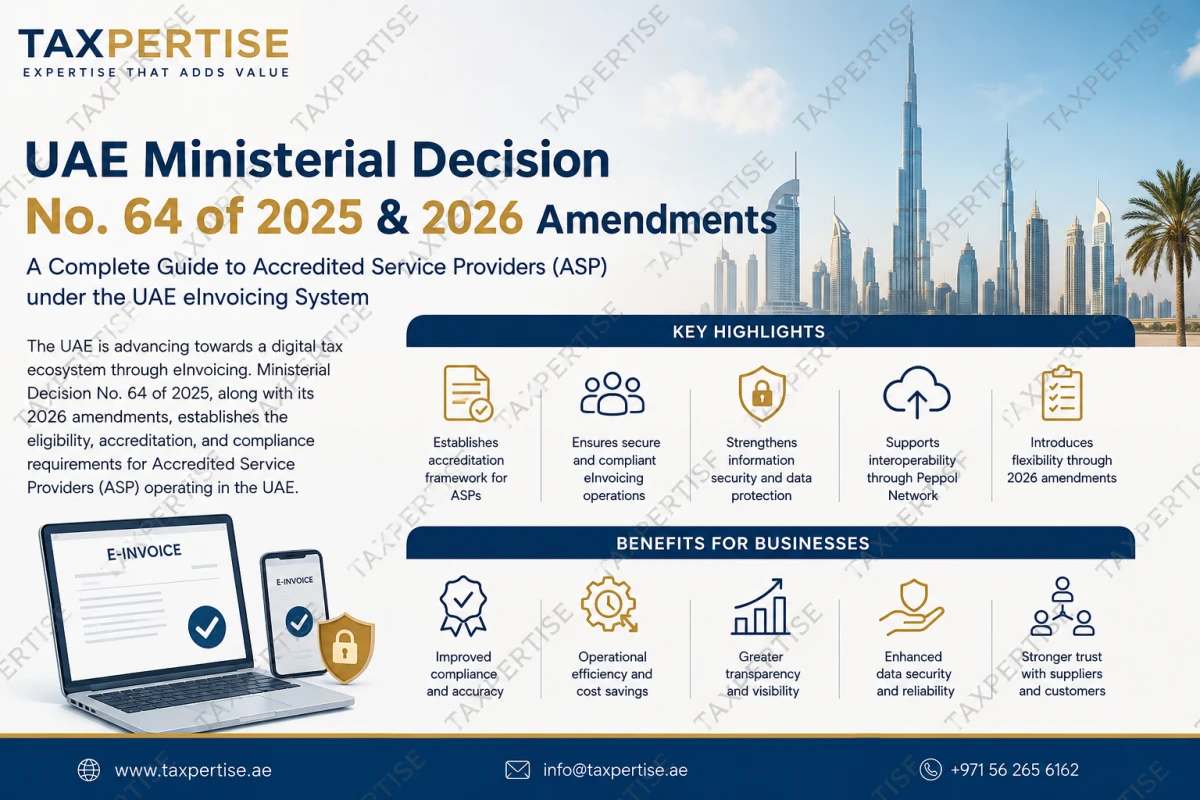
UAE Ministerial Decision No. 64 of 2025 & 2026 Amendments: Complete Guide to Accredited Service Providers (ASP) for UAE eInvoicing
The United Arab Emirates (UAE) is rapidly transforming its tax administration through digitalization. One of the most significant developments is the implementation of the UAE Electronic Invoicing (eInvoicing) System. To support this transformation, the Ministry of Finance introduced Ministerial Decision No. 64 of 2025, establishing the eligibility criteria and accreditation framework for Accredited Service Providers (ASPs).
The consolidated version, including the 2026 amendments, further strengthens the legal framework by refining accreditation requirements and implementation timelines. Although the Decision is primarily directed at technology providers, every UAE business expected to adopt eInvoicing should understand its practical implications.
What is UAE eInvoicing?
UAE eInvoicing is not simply sending invoices by email or generating PDF invoices.
Instead, it is a government-regulated digital invoicing ecosystem where invoices are created, exchanged, validated, and transmitted electronically in a structured format through accredited technology providers using internationally recognized standards.
The UAE has adopted the Peppol 5-Corner Model, allowing businesses to exchange invoices securely while supporting future tax reporting and digital compliance initiatives.
Objectives of UAE eInvoicing
- Improve VAT compliance.
- Reduce invoice fraud.
- Automate invoice processing.
- Increase transparency between trading partners.
- Support the UAE Digital Economy Strategy.
- Reduce manual intervention and operational costs.
What is Ministerial Decision No. 64 of 2025?
Ministerial Decision No. 64 of 2025 establishes the legal framework governing the accreditation of Accredited Service Providers (ASPs) participating in the UAE eInvoicing ecosystem.
The Decision specifies:
- Eligibility criteria for Service Providers.
- Accreditation procedures.
- Technical compliance requirements.
- Information security standards.
- Operational responsibilities.
- Monitoring by the Ministry of Finance.
- Suspension and cancellation procedures.
This framework ensures that only qualified providers can participate in the UAE's national eInvoicing infrastructure.
Featured Snippet: What is an Accredited Service Provider (ASP)?
An Accredited Service Provider (ASP) is a technology provider approved by the UAE Ministry of Finance to securely exchange electronic invoices through the UAE eInvoicing network. ASPs validate invoice data, convert invoices into the required structured format, connect businesses to the Peppol network, and ensure compliance with UAE technical standards.
What Does an Accredited Service Provider Do?
An Accredited Service Provider performs several critical functions within the UAE eInvoicing ecosystem.
- Converts invoices into the approved electronic format.
- Validates invoice data before transmission.
- Connects businesses to the UAE Peppol Network.
- Transmits invoices securely between suppliers and buyers.
- Maintains audit trails and transaction records.
- Ensures compliance with Ministry of Finance technical specifications.
- Supports ERP and accounting software integration.
Think of an ASP as the secure digital bridge between your accounting software and the national eInvoicing network.
Why Should UAE Businesses Care?
Although the Decision mainly regulates technology providers, it has significant implications for businesses operating in the UAE.
Every business required to adopt eInvoicing will eventually need to connect with an Accredited Service Provider.
Businesses should begin preparing by:
- Reviewing existing ERP and accounting software.
- Assessing system compatibility.
- Understanding future integration requirements.
- Monitoring Ministry of Finance implementation timelines.
- Planning internal process changes.
Early preparation minimizes implementation risks and ensures a smoother transition once mandatory compliance begins.
How Does the UAE eInvoicing System Work?
The UAE follows the internationally recognised Peppol 5-Corner Model.
- Supplier creates an invoice within ERP or accounting software.
- The invoice is sent to the supplier's Accredited Service Provider.
- The ASP validates the invoice against UAE standards.
- The invoice is transmitted through the Peppol Network.
- The buyer's Accredited Service Provider receives the invoice.
- The buyer receives the invoice electronically.
- Relevant invoice information becomes available within the UAE regulatory framework.
This model significantly improves automation, invoice accuracy, and interoperability between businesses.
Relationship with Other UAE eInvoicing Legislation
Ministerial Decision No. 64 of 2025 forms part of a broader legislative framework supporting UAE eInvoicing.
- Ministerial Decision No. 243 of 2025 — Electronic Invoicing System.
- Ministerial Decision No. 244 of 2025 — Implementation requirements and timelines.
- Ministerial Resolution No. 56 of 2026 — Amendments to the accreditation framework
Eligibility Criteria for Accredited Service Providers (ASP) under Ministerial Decision No. 64 of 2025
One of the primary objectives of Ministerial Decision No. 64 of 2025 is to ensure that only qualified and technically capable organizations participate in the UAE eInvoicing ecosystem. To achieve this, the Ministry of Finance has established comprehensive eligibility requirements that every prospective Accredited Service Provider (ASP) must satisfy before obtaining accreditation.
These requirements are designed to safeguard the integrity, security, availability, and interoperability of the UAE Electronic Invoicing System while ensuring businesses can exchange invoices securely and efficiently.
Who Can Apply to Become an Accredited Service Provider?
Organizations intending to operate as an ASP must demonstrate that they possess the legal, operational, technical, and financial capability to provide electronic invoicing services within the UAE.
The accreditation process is intended for technology providers capable of supporting businesses through secure electronic invoice exchange in accordance with UAE eInvoicing standards.
Key Eligibility Requirements
1. Legal Establishment
An applicant must be a legally established entity capable of entering contractual relationships and providing electronic invoicing services in accordance with applicable UAE laws.
2. Technical Capability
The applicant must demonstrate that its technology platform can:
- Generate structured electronic invoices.
- Validate invoice data.
- Transmit invoices securely.
- Receive electronic invoices.
- Support interoperability within the UAE eInvoicing network.
- Comply with Ministry of Finance technical specifications.
3. Information Security Framework
Security is one of the most critical aspects of the accreditation process.
Applicants are expected to implement comprehensive security controls designed to protect invoice information throughout its lifecycle, including:
- Confidentiality of business data.
- Integrity of electronic invoices.
- Secure communication channels.
- Access control mechanisms.
- Continuous monitoring.
- Incident response
2026 Amendments to Ministerial Decision No. 64 of 2025: What Changed?
The UAE Ministry of Finance introduced Ministerial Resolution No. 56 of 2026 to amend certain provisions of Ministerial Decision No. 64 of 2025. These amendments are intended to increase market readiness, provide greater flexibility for Service Providers, and support the successful implementation of the UAE Electronic Invoicing System while maintaining robust governance and accountability. 0
Overview of the Key Amendments
The amendments primarily focus on:
- Revising the eligibility criteria for accreditation.
- Introducing a dedicated article for experience requirements.
- Allowing greater use of third-party PSP products and outsourced services.
- Clarifying that the accredited Service Provider remains fully responsible for compliance.
- Providing the Minister with authority to waive certain accreditation conditions where appropriate.
1. Revised Eligibility Criteria for Accreditation
The amended Article 5 restructures the accreditation requirements and requires every applicant to satisfy a defined set of conditions before obtaining accreditation.
An applicant must:
- Be an active Peppol-certified Service Provider that has successfully completed OpenPeppol conformance testing.
- Meet the newly introduced experience requirements.
- Satisfy company registration conditions.
- Comply with the Service Provider operational requirements.
- Meet applicable tax registration obligations.
- Comply with PSP Product information security requirements.
- Submit the required self-declaration.
- Maintain the required insurance coverage.
These amendments strengthen the accreditation framework while making the assessment process more structured and transparent. 1
2. Greater Flexibility Through Third-Party Technology
One of the most significant amendments is the express recognition that an Accredited Service Provider may:
- Use a PSP Product owned by a third party.
- Outsource the development of the PSP Product.
- Outsource operational activities.
- Outsource management of electronic invoicing services.
However, outsourcing does not transfer regulatory responsibility.
The accredited Service Provider remains fully responsible for ensuring compliance with all accreditation conditions and for maintaining oversight of the electronic invoicing services delivered to customers. 2
3. New Experience Requirements (Article 5 bis)
The amendments introduce a dedicated provision governing experience requirements.
Instead of focusing only on the applicant entity, the amended framework allows the required experience to be demonstrated through the PSP Product used to provide electronic invoicing services, subject to the conditions specified in the Decision.
This approach enables greater participation by technology providers while maintaining confidence in the technical capability of the invoicing platform. 3
4. Minister's Discretion to Waive Certain Conditions
The amended Decision expressly provides that any condition specified in Article 5 may be waived by the Minister.
This discretionary authority introduces regulatory flexibility where justified by the circumstances while preserving the integrity of the accreditation framework. 4
Practical Impact on Service Providers
For technology companies seeking accreditation, the amendments provide several practical benefits:
- More flexibility in selecting technology solutions.
- Greater opportunity to partner with specialised software providers.
- Reduced barriers for organisations that operate through established PSP platforms.
- Clearer accreditation requirements.
- Improved certainty regarding regulatory expectations.
Practical Impact on UAE Businesses
Businesses that will eventually adopt UAE eInvoicing should also understand these amendments because they influence the market of Accredited Service Providers.
Businesses can expect:
- A wider selection of accredited providers.
- More competitive implementation options.
- Greater ERP integration choices.
- Continued assurance that accredited providers remain accountable, even where third-party technology is used.
Compliance Checklist for Businesses
- Review whether your ERP or accounting software supports UAE eInvoicing.
- Monitor the list of Accredited Service Providers published by the Ministry of Finance.
- Assess integration requirements before mandatory implementation.
- Update internal invoicing processes where necessary.
- Train finance, tax, and IT teams on future electronic invoicing requirements.
Frequently Asked Questions
Can an Accredited Service Provider outsource its technology platform?
Yes. The amendments expressly permit the use of third-party PSP Products and outsourcing of development, operation, or management. However, the accredited Service Provider remains fully responsible for compliance with the Ministerial Decision. 5
Does outsourcing reduce the Service Provider's regulatory responsibility?
No. Regulatory responsibility remains entirely with the Accredited Service Provider regardless of any outsourcing arrangements. 6
Do these amendments change the requirement to become Peppol certified?
No. The amended eligibility criteria continue to require applicants to be active Peppol-certified Service Providers that have successfully completed the applicable conformance tests. 7
Final Thoughts
The 2026 amendments do not fundamentally change the UAE's eInvoicing strategy. Instead, they refine the accreditation framework by introducing greater operational flexibility while reinforcing accountability and security.
For Accredited Service Providers, the amendments create a more practical pathway to accreditation. For UAE businesses, they should result in a broader and more competitive ecosystem of compliant technology providers without compromising regulatory oversight.
As the UAE progresses toward mandatory eInvoicing implementation, businesses should begin evaluating their systems, engaging with prospective Accredited Service Providers, and preparing for a smooth transition to the new digital invoicing framework. 8
Need Expert Guidance on UAE eInvoicing?
TAXPERTISE assists UAE businesses with VAT compliance, ERP readiness assessments, eInvoicing implementation planning, and regulatory advisory. Whether you are evaluating an Accredited Service Provider or preparing your finance systems for mandatory eInvoicing, our specialists can help you navigate the transition with confidence.
What's Your Reaction?
 Like
0
 Dislike
0
 Love
0
 Funny
0
 Wow
0
 Sad
0
 Angry
0







Comments (0)