
UAE PPP Projects Manual Explained: Key Highlights and Tax Implications for Businesses
Explore the UAE PPP Projects Manual under Federal Law No. 12 of 2023, including key PPP governance highlights, project structures, and important corporate tax and VAT implications for businesses participating in Public-Private Partnerships.

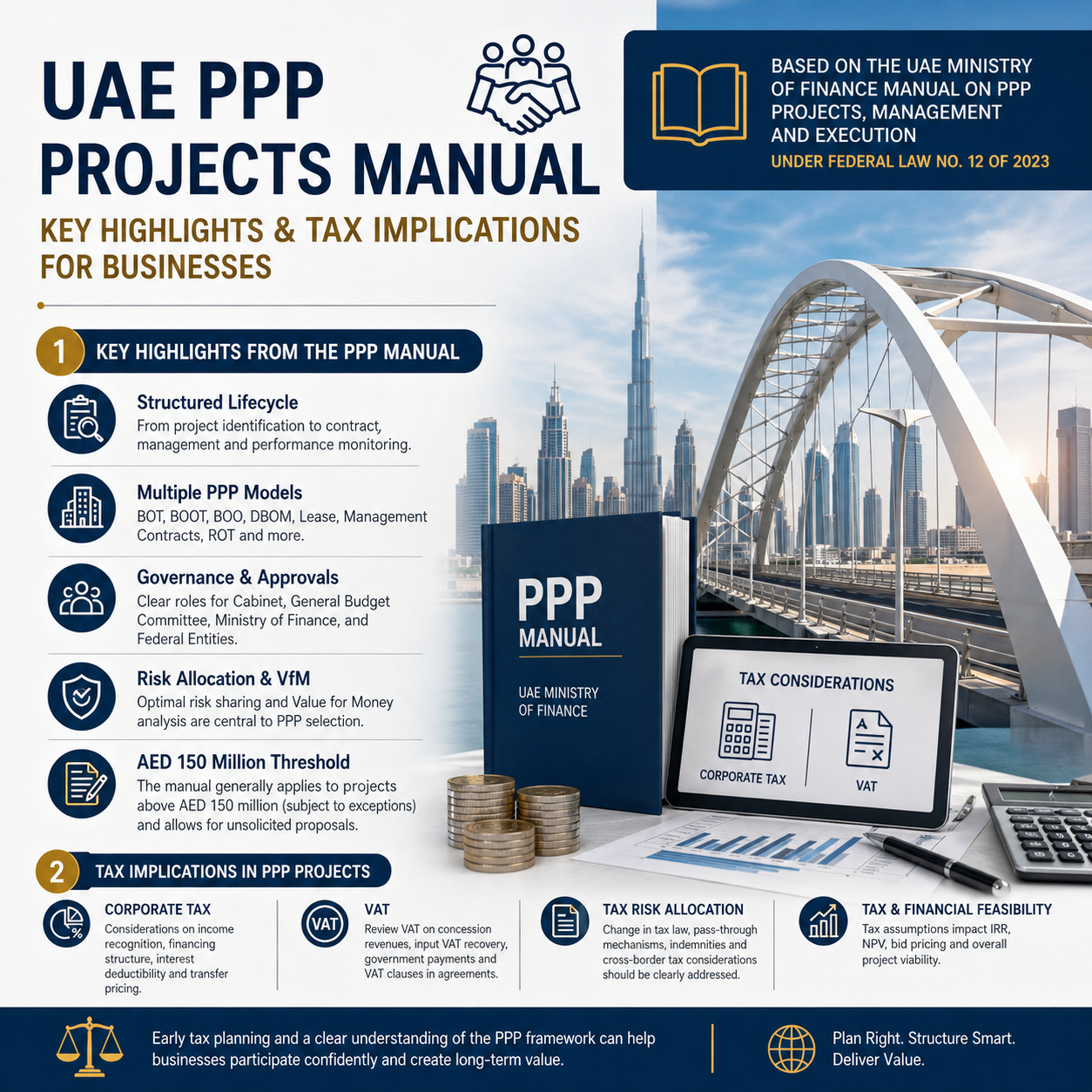
UAE PPP Projects Manual Explained: Key Highlights and Tax Implications for Businesses
The UAE Ministry of Finance’s Manual on PPP Projects, Management and Execution, issued under Federal Law No. 12 of 2023, introduces a comprehensive framework governing Public-Private Partnerships (PPP) at the federal level. The manual is designed to enhance private sector participation in infrastructure and public services while ensuring strong governance, transparency, and value for money.
For businesses, investors, contractors, and tax professionals, understanding this manual is important not only from a project delivery perspective but also from a tax planning standpoint. This article first highlights the key provisions of the UAE PPP Manual, followed by the tax implications businesses should consider.
Part 1: Key Highlights of the UAE PPP Projects Manual
1. Structured PPP Lifecycle Framework
The manual establishes a full lifecycle framework for PPP projects, including:
- Project Identification – Federal entities assess projects based on public benefit, private sector capability, risk transfer potential, and project significance.
- Project Screening and Pre-Feasibility – Includes prioritization, technical feasibility, financial feasibility, legal due diligence, market assessment, and socio-economic review.
- Project Appraisal – Detailed feasibility studies cover Value for Money (VfM), risk allocation, contracting model selection, and tendering plans.
- Tendering and Partner Selection – Covers expressions of interest, prequalification, RFP issuance, bid evaluation, and financial close.
- Contract Management – Focuses on performance monitoring, KPIs, contract administration, and long-term oversight.
2. Recognized PPP Models in the UAE
The manual recognizes several PPP models that may be adopted depending on project requirements, including:
- BOT (Build-Operate-Transfer)
- BOOT (Build-Own-Operate-Transfer)
- BOO (Build-Own-Operate)
- DBOM / DBFOMT models
- Lease and Management Contracts
- ROT rehabilitation models
Payment structures may include:
- User-pay models
- Government-pay models
- Hybrid payment structures
3. Governance and Approval Structure
The manual establishes clear governance roles for:
- Cabinet
- General Budget Committee
- Ministry of Finance (PPP Section)
- Concerned Federal Entities
- Project Teams
- Private Sector Participants
This structure is intended to strengthen transparency, accountability, and institutional oversight throughout the PPP lifecycle.
4. Value for Money and Risk Allocation
A central principle of the PPP framework is optimal risk allocation, assigning risks to the party best able to manage them. The manual also emphasizes Value for Money (VfM) analysis as a key factor in determining whether a project should be procured through a PPP model.
5. AED 150 Million Threshold and Unsolicited Proposals
The manual generally applies to projects above AED 150 million, subject to exceptions. It also introduces a framework for unsolicited proposals, allowing private sector participants to propose PPP opportunities, subject to review and competitive tendering.
Part 2: Tax Implications of PPP Structures in the UAE
Although the manual is primarily a governance and project execution document, PPP arrangements may involve significant tax considerations.
1. UAE Corporate Tax Considerations
PPP projects are often implemented through special purpose vehicles (SPVs), which may raise Corporate Tax considerations, including:
- Tax treatment of concession or availability payment income
- Recognition of construction versus operating phase revenues
- Financing and interest deductibility considerations
- Transfer pricing implications for related-party arrangements
2. VAT Considerations in PPP Projects
VAT may be a material consideration, particularly where significant infrastructure CAPEX is involved.
Areas that may require review include:
- VAT treatment of concession revenues and service charges
- Input VAT recovery on construction and operational costs
- VAT implications of government payments and support mechanisms
- Tax clauses embedded in concession agreements
3. Tax Risk Allocation in PPP Contracts
Given the long-term nature of PPP agreements, contractual tax risk allocation may be critical, including:
- Change in tax law provisions
- Corporate Tax and VAT pass-through mechanisms
- Tax indemnity clauses
- Cross-border tax considerations for foreign sponsors or lenders
4. Tax and Financial Feasibility
Because the manual places significant emphasis on project IRR, NPV, and Value for Money, tax assumptions may directly impact:
- Project viability
- Bid pricing
- Investor returns
- Financial model outcomes
Conclusion
The UAE PPP Projects Manual establishes a robust framework for delivering strategic projects through public-private collaboration. For businesses considering PPP opportunities in the UAE, understanding the manual is only part of the equation.
Corporate Tax, VAT implications, financing structures, and tax risk allocation should also form part of early-stage planning to support compliant and commercially efficient project participation.
As PPP activity develops in the UAE, integrating legal, commercial, and tax analysis will become increasingly important for investors and project sponsors alike.
What's Your Reaction?
 Like
0
 Dislike
0
 Love
0
 Funny
0
 Wow
0
 Sad
0
 Angry
0







Comments (0)