
UAE Excise Tax Update: FTA Clarification EXTP014 on Natural Losses in Excise Goods
Understand UAE FTA Public Clarification EXTP014 on natural losses in excise goods, including qualifying conditions, reporting requirements, designated zone implications, and practical compliance considerations for excise taxpayers.

UAE Excise Tax Update: FTA Clarification EXTP014 on Natural Losses in Excise Goods
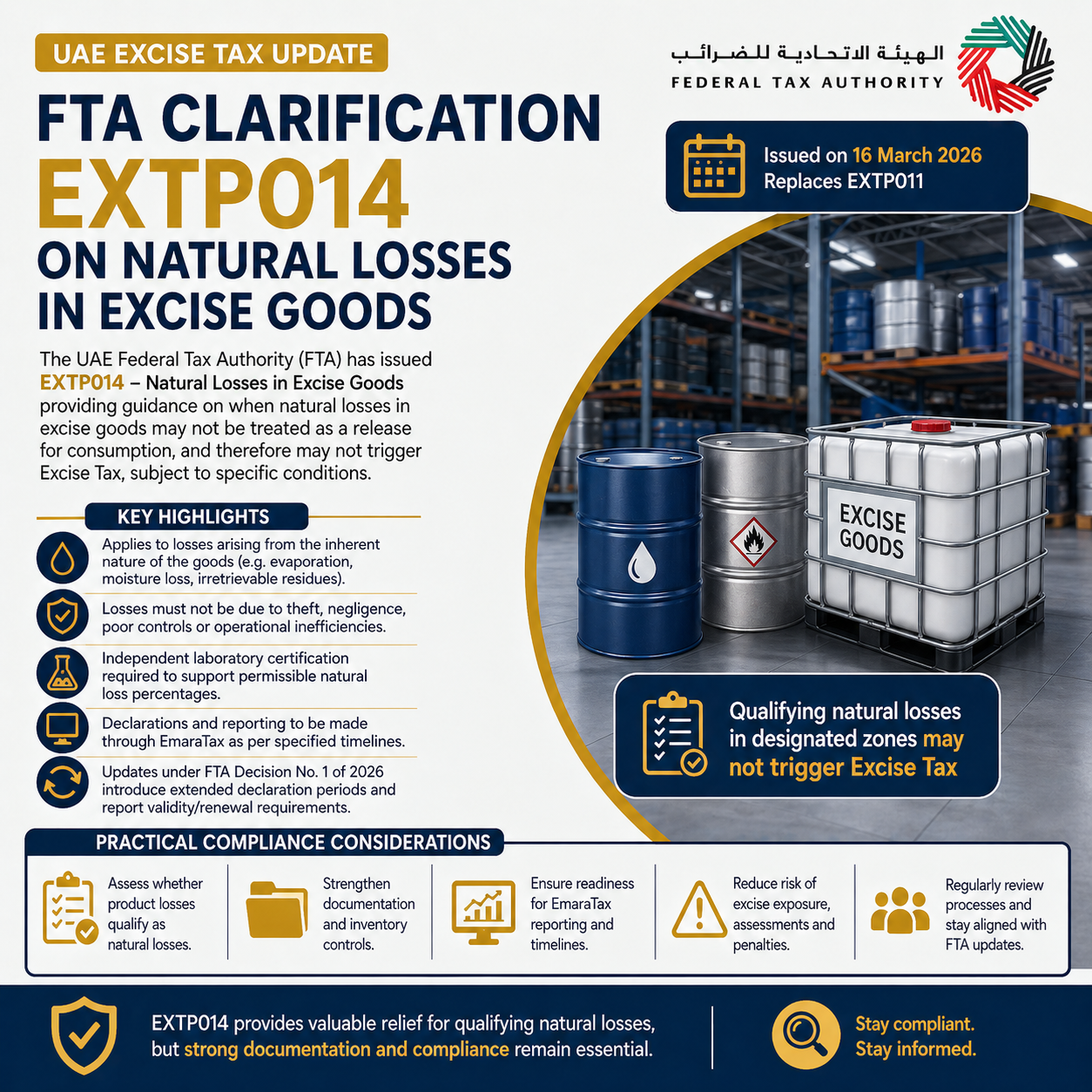
Based on FTA Public Clarification EXTP014 – Natural Losses in Excise Goods issued in March 2026, the UAE Federal Tax Authority has provided important guidance on the treatment of natural losses of excise goods and when such losses may not trigger Excise Tax, subject to prescribed conditions.
For warehouse keepers, importers, manufacturers and businesses operating in designated zones, this clarification is significant as it addresses the treatment of unavoidable shortages arising from the inherent characteristics of excise goods while reinforcing documentation and reporting expectations.
Part 1 – Key Highlights of FTA Clarification EXTP014
What Are Natural Losses in Excise Goods?
Natural losses generally refer to unavoidable losses arising due to the inherent nature of excise goods, which may include:
- Evaporation losses
- Moisture reduction
- Irretrievable product residues
- Other inherent losses caused by the nature of the goods
The clarification distinguishes such losses from losses arising due to theft, negligence, poor controls or operational inefficiencies, which would generally not qualify as natural losses.
Can Qualifying Natural Losses Trigger Excise Tax?
One of the key clarifications under EXTP014 is that qualifying natural losses in designated zones may not be treated as a release for consumption and therefore may not result in Excise Tax becoming due, provided all conditions are met.
Broadly, this may require:
- The losses arise due to the inherent characteristics of the goods
- Losses remain within permissible natural loss thresholds
- Supporting evidence is maintained
- Required declarations and reporting obligations are fulfilled
Importantly, relief is not automatic and depends on satisfying documentary and procedural conditions.
Independent Laboratory Certification
A significant compliance feature under EXTP014 is support from an independent competent entity, including laboratory reports supporting:
- Permissible natural loss percentages
- Technical basis for the losses claimed
- Substantiation for declarations made to the FTA
Businesses should assess whether existing product loss assumptions align with certified permissible thresholds.
Reporting Requirements and EmaraTax Compliance
The clarification also reinforces compliance requirements relating to declarations and reporting through EmaraTax, together with procedural expectations surrounding supporting reports, validity periods and renewals.
Businesses should review whether internal compliance processes are aligned with the latest requirements.
Who Should Review EXTP014?
This clarification may be particularly relevant for:
- Warehouse keepers in designated zones
- Manufacturers of excise goods
- Importers and distributors
- Storage and logistics operators handling excise goods
Part 2 – Practical Compliance Considerations for Excise Taxpayers
1. Assess Whether Product Losses Qualify as Natural Losses
Businesses should review whether product shortages currently experienced may potentially fall within the natural loss framework under EXTP014.
2. Strengthen Documentation and Inventory Controls
Documentation is likely to be central to supporting any natural loss treatment. Businesses should review:
- Inventory reconciliation procedures
- Loss monitoring controls
- Technical support and product data
- Supporting evidence maintained for FTA purposes
3. Review Reporting Readiness
Processes should be assessed to ensure readiness for declaration and reporting obligations through EmaraTax within applicable timelines.
4. Reassess Excise Tax Risk Exposure
Where natural losses are unsupported or incorrectly treated, businesses may face potential exposure to:
- Excise Tax assessments
- Administrative penalties
- Disputes during FTA reviews
- Compliance risks linked to documentation gaps
Why EXTP014 Matters
The clarification may provide relief for qualifying natural losses, but it also raises the bar on evidence, controls and compliance procedures.
For many excise taxpayers, the focus should move beyond identifying product losses to ensuring such losses can be technically supported and procedurally defended.
Frequently Asked Questions (FAQs)
What is considered natural loss in excise goods in UAE?
Natural losses may include unavoidable shortages arising from the inherent nature of excise goods, such as evaporation, moisture reduction and irretrievable residues.
Can natural losses trigger Excise Tax in UAE?
Qualifying natural losses may not trigger Excise Tax where prescribed conditions and reporting requirements are satisfied.
Is laboratory certification required under EXTP014?
Supporting certification from a competent independent entity may be required to substantiate permissible natural loss percentages.
Does EXTP014 apply to all product losses?
No. Losses caused by theft, negligence or operational inefficiencies would generally not fall within natural loss treatment.
Final Thoughts
FTA Public Clarification EXTP014 is a significant development for businesses dealing in excise goods, particularly in designated zones. While it may provide relief for qualifying natural shortages, businesses should carefully review processes, documentation standards and reporting readiness to ensure compliance.
Early assessment of the practical impact of EXTP014 can help businesses manage excise tax exposure while strengthening operational controls.
If your business deals with excise goods and requires support assessing the implications of EXTP014, professional review at an early stage may help mitigate compliance risks.
What's Your Reaction?
 Like
0
 Dislike
0
 Love
0
 Funny
0
 Wow
0
 Sad
0
 Angry
0







Comments (0)