
Dubai Salik & Parkin VAT Update 2026: Full Impact on Road Tolls, Parking Fees, Businesses & UAE Motorists
Starting June 1, 2026, Dubai introduces 5% VAT on Salik tolls and Parkin parking services. Learn the new charges, business impact, updated parking rules, Salik tag costs, and what UAE motorists and companies need to know.

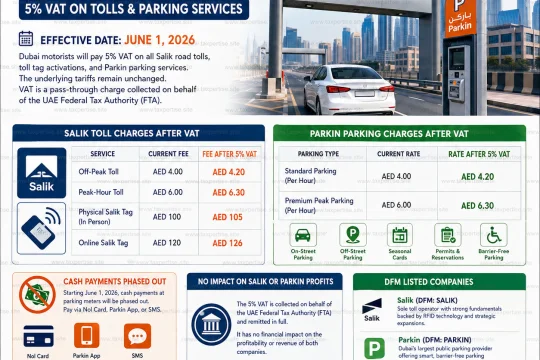
Dubai Introduces 5% VAT on Salik & Parkin Services from June 1, 2026
Dubai motorists and businesses will soon experience a significant procedural change in daily transportation costs as the UAE introduces a 5% Value Added Tax (VAT) on Salik road tolls, Salik tag activations, and Parkin public parking services effective June 1, 2026.
While the base tariffs remain unchanged, the newly added VAT component will increase the final payable amount for drivers across Dubai. The tax will be collected by the operators and fully remitted to the Federal Tax Authority (FTA), meaning the additional amount is a statutory government levy rather than an operational price increase.
What Is Changing from June 1, 2026?
The UAE government has confirmed that a 5% VAT will apply to:
- Salik toll gate charges
- Salik tag activation fees
- Public parking charges under Parkin
- Seasonal parking cards
- Parking permits and reservations
- Barrier-free smart parking services
This move aligns these transportation-related services with the UAE VAT framework introduced in 2018 and reflects Dubai’s continued transition toward a fully digitized smart mobility ecosystem.
New Salik Toll Charges After VAT
Dubai’s automated toll operator Salik will now apply VAT directly on toll usage charges and tag purchases.
| Service | Current Fee | Fee After 5% VAT |
|---|---|---|
| Off-Peak Toll | AED 4.00 | AED 4.20 |
| Peak-Hour Toll | AED 6.00 | AED 6.30 |
| Physical Salik Tag (In Person) | AED 100 | AED 105 |
| Online Salik Tag | AED 120 | AED 126 |
The VAT element may appear relatively minor per transaction, but for logistics companies, delivery fleets, ride-hailing operators, transport businesses, and frequent commuters, the annual cumulative increase could become financially material.
Parkin Parking Charges Also Increase by 5%
Dubai’s public parking operator Parkin will also begin charging VAT on all parking-related services from June 2026.
| Parking Type | Current Rate | Rate After VAT |
|---|---|---|
| Standard Parking (Per Hour) | AED 4.00 | AED 4.20 |
| Premium Peak Parking (Per Hour) | AED 6.00 | AED 6.30 |
The VAT applies to:
- On-street parking
- Off-street parking
- Monthly and seasonal subscriptions
- Parking reservations
- Special parking permits
Cash Payments at Parking Meters Being Phased Out
Alongside the VAT implementation, Dubai is accelerating its transition toward cashless parking systems.
Starting June 1, 2026, physical cash payments at parking meters will gradually be phased out. Motorists are encouraged to use:
- Nol Cards
- Parkin Mobile App
- SMS Parking Payments
- Digital Wallet Solutions
This initiative supports Dubai’s broader Smart City strategy focused on automation, operational efficiency, and digital mobility services.
Impact on UAE Businesses and Corporate Accounting
For businesses operating fleets, delivery operations, transportation services, employee mobility programs, or client visit operations, the VAT implementation introduces important accounting and compliance considerations.
Key Corporate Tax & VAT Considerations
- Additional transportation overhead costs may increase operational expenses.
- VAT-registered businesses may recover input VAT subject to UAE VAT recovery rules.
- Companies should ensure proper tax invoices and transaction records are maintained.
- ERP systems, accounting software, and expense policies may require updates.
- Fleet-heavy industries should reassess annual transportation budgets.
Businesses using accounting systems such as Zoho Books, QuickBooks Online (QBO), and Odoo should ensure that automated expense categorizations properly account for VAT-inclusive toll and parking charges.
No Financial Benefit to Salik or Parkin
Both operators clarified that the VAT collection mechanism will have no direct impact on company profitability or operational revenue.
The additional 5% amount is purely collected on behalf of the UAE Federal Tax Authority and transferred to the government in line with UAE VAT legislation.
This means:
- The underlying service price remains unchanged.
- The VAT is a statutory pass-through charge.
- Revenue growth figures will not materially benefit from the VAT addition itself.
Dubai Financial Market (DFM) Investor Interest
Investors continue monitoring both listed entities on the Dubai Financial Market (DFM).
Salik (DFM: SALIK)
Salik remains Dubai’s sole toll gate operator and continues expanding its smart mobility infrastructure through RFID automation and strategic partnerships, including collaborations linked to Dubai Airports and urban traffic optimization initiatives.
Parkin (DFM: PARKIN)
Parkin continues to maintain strong positioning as Dubai’s largest public parking operator, particularly through:
- Barrier-free parking technology
- Smart parking systems
- Integrated digital payment infrastructure
- Urban mobility optimization
What UAE Motorists Should Expect
Although the immediate financial increase appears modest, regular commuters may notice higher monthly transportation expenses over time.
Motorists are advised to:
- Shift toward digital parking payments
- Monitor monthly toll usage
- Review transportation budgets
- Use smart mobility apps for route optimization
- Track VAT-inclusive business travel expenses properly
Final Thoughts
The introduction of 5% VAT on Salik and Parkin services represents another step in the UAE’s ongoing modernization of taxation, infrastructure monetization, and digital mobility management.
While the adjustment marginally increases transportation costs for residents and businesses, it also reinforces Dubai’s broader economic framework focused on transparency, digital transformation, and sustainable urban infrastructure funding.
As Dubai continues expanding smart city initiatives and mobility automation, motorists and businesses alike should prepare operationally, financially, and technologically for the evolving transportation ecosystem.
For businesses, ensuring accurate VAT accounting treatment and expense documentation will remain critical to maintaining compliance under UAE tax regulations.
What's Your Reaction?
 Like
0
 Dislike
0
 Love
0
 Funny
0
 Wow
0
 Sad
0
 Angry
0







Comments (0)