
Executive Regulation of UAE Tax Procedures – Complete Guide 2026
Complete guide to UAE Tax Procedures Executive Regulation (Cabinet Decision 74 of 2023) including record keeping, voluntary disclosure, audits, and compliance rules.

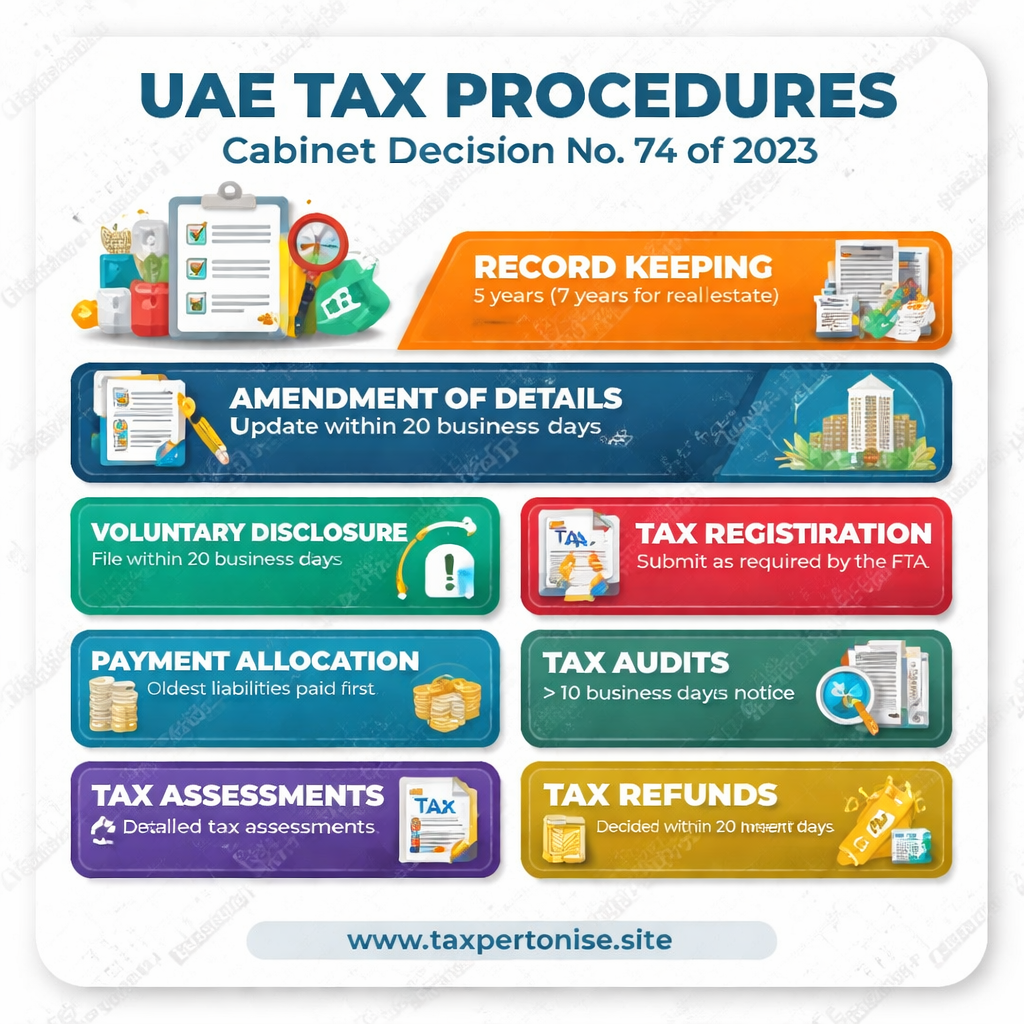
Executive Regulation of UAE Tax Procedures – Cabinet Decision No. 74 of 2023 (Updated 2026)
The Executive Regulation of Federal Decree-Law No. 28 of 2022 on Tax Procedures, issued through Cabinet Decision No. 74 of 2023 and amended by Cabinet Decision No. 17 of 2026, establishes the procedural framework governing tax compliance in the UAE.
This regulation defines record keeping, tax audits, voluntary disclosure, registration procedures, and administrative processes applicable to all taxpayers dealing with the Federal Tax Authority (FTA).
1. Record Keeping Requirements (Article 2)
Taxable persons are required to maintain comprehensive accounting records and supporting documents.
- Financial statements (P&L, balance sheet)
- Sales and purchase records
- Inventory records
- Payroll and wage records
- Fixed asset registers
- Contracts, invoices, and correspondence
These records must be sufficient to allow the FTA to verify tax obligations.
2. Record Retention Period (Article 3)
- 5 years for taxable persons
- 7 years for real estate records
Additional retention periods apply in cases of:
- Tax audits
- Disputes
- Voluntary disclosures
- Pending refund applications
3. Method of Record Keeping (Article 4)
Records may be maintained:
- Physically
- Electronically (provided they are identical and reproducible)
The FTA may request records to be produced in a readable format at any time.
4. Tax Registration and Amendments (Article 6)
Tax registration must be submitted in the form specified by the FTA.
Amendment Requirement:
- Any change in registration data must be reported within 20 business days
- This includes changes in:
- Name, address, email
- Business activities
- Legal structure
- Business location
5. Voluntary Disclosure (Article 10)
Voluntary Disclosure is required when a taxpayer becomes aware of an error in:
- Tax Return
- Tax Assessment
- Refund Application
Key Rules:
- Submit within 20 business days from awareness
- If error exceeds AED 10,000 → VD is mandatory
- If ≤ AED 10,000 → correction allowed in next return (if applicable)
6. Allocation of Payments (Article 9)
If a taxpayer does not specify the allocation of payment:
- The FTA allocates it to the oldest outstanding liabilities
- Excess payments are treated as credit balance
7. Tax Audits (Articles 15–19)
The FTA has authority to conduct tax audits where necessary.
Key Provisions:
- Minimum 10 business days notice before audit
- FTA may inspect:
- Premises
- Documents
- Electronic systems
- FTA may seize documents and assets if required
- Audit results must be issued within 10 business days
8. Tax Assessment and Penalties (Articles 20–21)
Tax assessments must include:
- Taxpayer details
- Tax calculation and adjustments
- Reasons for assessment
- Amount payable or refundable
Once issued, the assessed tax becomes a payable debt to the Authority.
9. Refund Procedures (Article 26)
- FTA must decide within 20 business days
- Refund processed within 5 business days after approval
Refunds may be delayed if pending tax returns are not submitted.
10. Key Compliance Takeaways
- Maintain records for at least 5 years
- Update registration within 20 business days
- Submit VD within 20 business days
- Be audit-ready at all times
- Ensure accurate and complete documentation
11. Language Requirements (Article 5)
Under Article 5 of Cabinet Decision No. 74 of 2023, the Federal Tax Authority (FTA) regulates the language of tax-related records and documents.
Key Provisions:
- The FTA may accept documents submitted in English
- The FTA may require translation into Arabic where necessary
- Translations must be legally approved in accordance with UAE regulations
- The taxpayer must provide translation within the timeframe specified by the FTA
This Article ensures that the FTA can review and verify tax information in a standardized language format when required.
12. Obligations of Licensing Authorities (Article 7)
Article 7 of Cabinet Decision No. 74 of 2023 imposes obligations on government licensing authorities to share business information with the FTA.
Key Provisions:
- Authorities must notify the FTA within 20 business days of issuing or renewing a trade license
- Information shared includes:
- Name of the licensee
- Trade license details
- Registered address
- Business activities
- Details of owners, partners, and directors
- The FTA may request additional information if required
This provision enhances data transparency and coordination between government entities and the FTA.
13. Legal Representative (Article 8)
Article 8 of Cabinet Decision No. 74 of 2023 outlines the rules governing the appointment and notification of a Legal Representative for tax purposes.
Key Provisions:
- A Legal Representative must notify the FTA of their appointment
- The notification must include:
- Name and address of the Legal Representative
- Name and details of the Taxable Person
- Tax Registration Number (if applicable)
- مدة التعيين (Duration of appointment, if fixed-term)
- Responsibilities of the Legal Representative
- The FTA may request additional supporting documents
- The FTA will notify acceptance within 20 business days
This Article ensures proper authorization and accountability when a person represents a taxpayer before the FTA.
Conclusion
Cabinet Decision No. 74 of 2023 provides a comprehensive procedural framework for UAE tax compliance. It emphasizes documentation, timely reporting, and transparency, forming the backbone of interactions with the Federal Tax Authority.
Businesses must align their internal systems with these requirements to ensure full compliance and audit readiness.
What's Your Reaction?
 Like
0
 Dislike
0
 Love
0
 Funny
0
 Wow
0
 Sad
0
 Angry
0









Comments (0)