
UAE VAT on Advances & Retention Payments: Avoid Hidden Tax Liabilities in Contracts
Learn how advance payments and retention clauses impact UAE VAT under Articles 25 & 26. Avoid cash flow risks and FTA audit exposure with proper contract structuring.

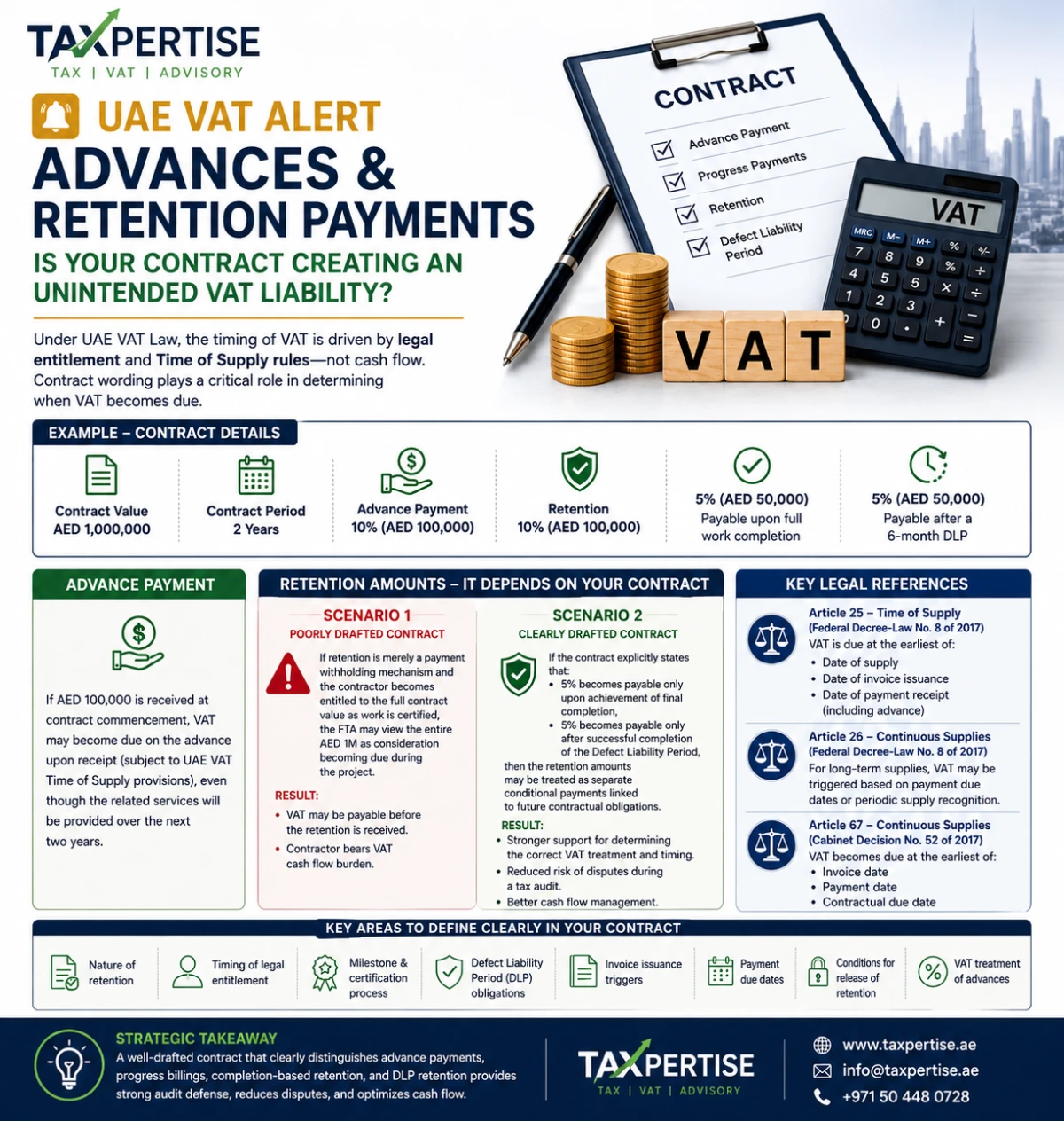
UAE VAT on Advances & Retention Payments: Is Your Contract Creating Hidden Tax Liabilities?
In the UAE, VAT is not driven by cash flow — it is driven by legal entitlement and Time of Supply rules. Many businesses focus heavily on commercial terms but overlook how advance payments and retention clauses can unintentionally trigger early VAT liabilities.
Under Federal Decree-Law No. 8 of 2017 and its Executive Regulations, contract wording plays a decisive role in determining when VAT becomes due.
---🔍 Legal Framework Governing VAT Timing
Article 25 – Time of Supply (General Rule)
VAT becomes due at the earliest of:
- Date of supply
- Date of invoice issuance
- Date of payment receipt (including advance)
Article 26 & Article 67 – Continuous Supplies
For long-term contracts (e.g., construction over multiple years), VAT may be triggered based on:
- Contractual due dates
- Milestone billing
- Periodic supply recognition
⚠️ Risk: If milestones are unclear, the Federal Tax Authority (FTA) may impose periodic VAT recognition, regardless of actual cash flow.
---📊 Practical Example
- Contract Value: AED 1,000,000
- Contract Period: 2 Years
- Advance Payment: 10% (AED 100,000)
- Retention: 10% (AED 100,000)
- 5% upon completion
- 5% after 6-month Defect Liability Period (DLP)
💰 VAT Treatment of Advance Payments
Where an advance of AED 100,000 is received at contract commencement:
VAT is immediately triggered under Article 25, even though services will be delivered over two years.
Key Insight:
- VAT arises on receipt of advance OR
- Issuance of invoice, whichever is earlier
This creates an immediate cash flow burden if not properly planned.
---⚠️ VAT Treatment of Retention Payments – Critical Risk Area
The VAT treatment of retention depends on whether it is:
- Earned consideration (unconditional), OR
- Contingent consideration (conditional)
🔴 Scenario 1 – Poorly Drafted Contract (High Risk)
If the contract states that the contractor is entitled to the full contract value upon certification of work, and retention is merely withheld:
- Retention is treated as deferred payment
- Full AED 1M becomes taxable progressively
- VAT is payable before cash is received
Outcome: Significant negative cash flow impact and high audit risk.
---🟢 Scenario 2 – Well-Drafted Contract (Optimized Position)
If the contract clearly states that:
- 5% is payable only upon final completion
- 5% is payable only after successful DLP completion
Then retention qualifies as contingent consideration.
- VAT is triggered only when conditions are met
- Aligned with actual entitlement
- Improved cash flow management
📌 FTA Guidance Supporting Retention Treatment
According to FTA guidance, retention payments may be treated separately and recognized when actually paid, supporting the position that VAT timing aligns with entitlement and payment conditions.
This reinforces the importance of clear contractual structuring.
---🧠 Why Contract Drafting is a VAT Risk Area
The FTA evaluates:
- Legal entitlement (not accounting treatment)
- Contract wording and clauses
- Certification and approval mechanisms
- Timing of enforceable rights
⚠️ Key Principle: VAT is based on substance over form.
---📋 Key Contractual Areas to Define Clearly
- Nature of retention (conditional vs withheld)
- Timing of legal entitlement
- Milestone and certification process
- Defect Liability Period obligations
- Invoice issuance triggers
- Payment due dates
- Conditions for release of retention
- VAT treatment of advances
🚨 Common VAT Mistakes Businesses Make
- Assuming VAT follows cash receipt
- Ignoring invoice-triggered VAT liability
- Poorly drafted retention clauses
- Lack of milestone clarity in long-term contracts
- Failure to assess continuous supply rules
🎯 Strategic Takeaway
Under UAE VAT Law (Articles 25 & 26 and Article 67 of the Executive Regulations), VAT timing is driven by contractual entitlement—not cash flow.
A contract that clearly distinguishes:
- Advance payments
- Progress billings
- Completion-based retention
- DLP-based retention
provides strong audit defense, reduces disputes, and optimizes cash flow.
---📞 Expert Advisory
Let's connect, If your contracts involve advances, retention, or long-term service arrangements, a VAT contract review is essential to avoid unintended liabilities.
What's Your Reaction?
 Like
0
 Dislike
0
 Love
0
 Funny
0
 Wow
0
 Sad
0
 Angry
0









Comments (0)