
Transfer Pricing in UAE (2026): Complete Guide with Step-by-Step TP Assessment
This is not theory-heavy fluff. This is a structured, practitioner-grade roadmap that takes a reader from zero → performing an initial TP assessment (UAE + OECD aligned).

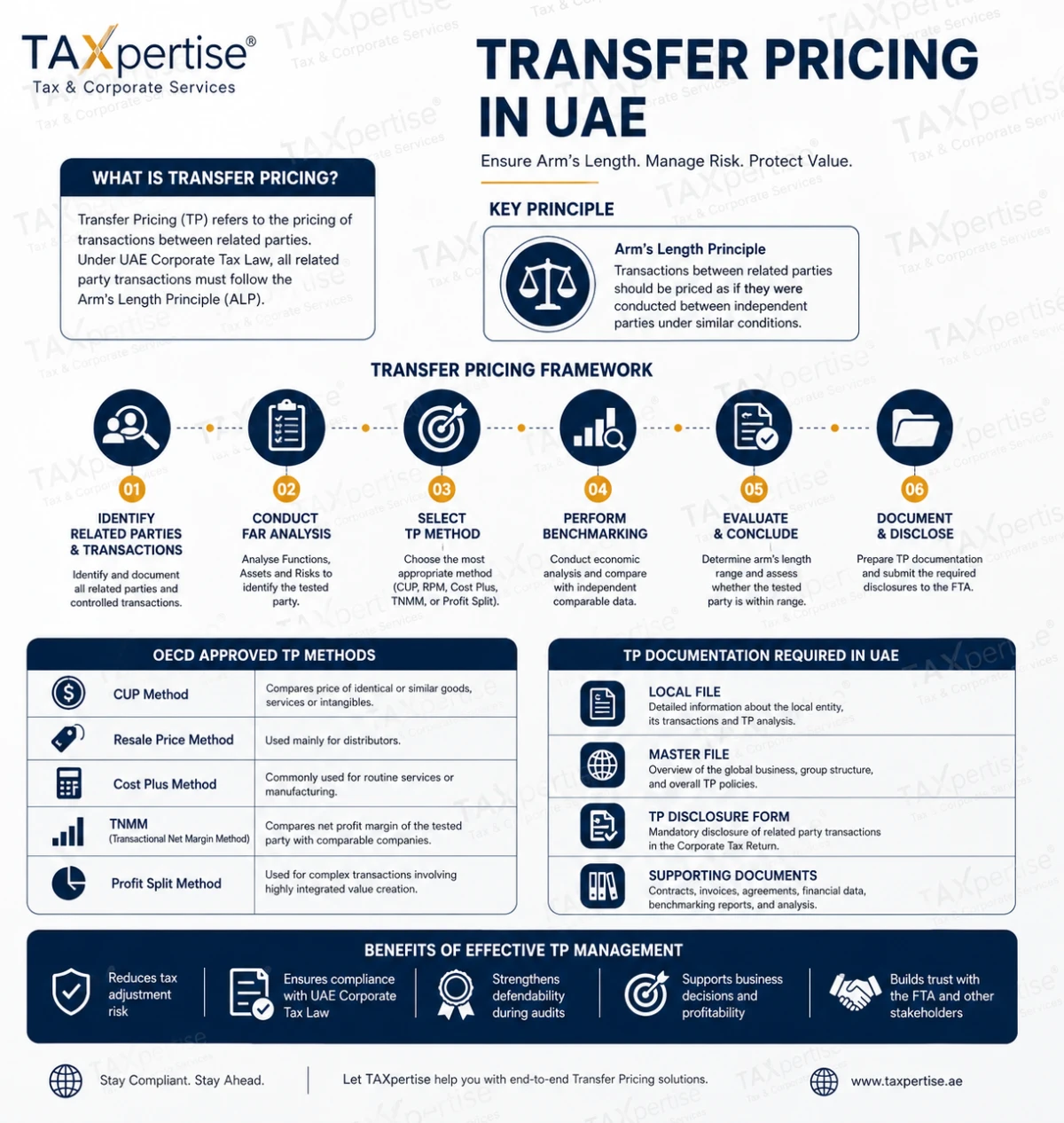
Transfer Pricing in UAE: The Most Misunderstood Risk in Corporate Tax
Most UAE businesses believe Transfer Pricing is:
“Just documentation”
That assumption is dangerously wrong.
In reality, Transfer Pricing is:
A direct determinant of your taxable income under UAE Corporate Tax
If your pricing is not at arm’s length:
- Your expenses can be disallowed
- Your profits can be increased artificially
- Your tax liability can rise significantly
Why Transfer Pricing Matters More in UAE (Post Corporate Tax Era)
Before Corporate Tax:
- TP = low enforcement risk
After Corporate Tax:
- TP = core audit trigger for FTA
The Federal Tax Authority (FTA) is now focused on:
- Profit shifting
- Artificial losses
- Excessive related party charges
👉 Especially in:
- Freezone structures
- Group service arrangements
- Management fee models
What is Transfer Pricing? (Technical + Practical View)
Transfer Pricing refers to:
The pricing of transactions between related parties, which must reflect market-based conditions.
UAE Legal Basis:
- Federal Decree-Law No. 47 of 2022
- Article 34 → Arm’s Length Principle
- OECD Transfer Pricing Guidelines
Arm’s Length Principle (ALP): The Core Rule
The entire TP framework is built on one concept:
Would two independent companies agree to this price?
If the answer is No → Adjustment Risk
Identifying Related Party Transactions (UAE Context)
Under UAE Corporate Tax, related parties include:
- Parent–subsidiary relationships
- Entities under common control
- Family-owned structures
- Economically dependent entities
Real UAE Scenario (Critical Insight)
A UAE company:
- Pays AED 2M management fee to parent
- Generates AED 8M revenue
- Reports minimal profit
👉 From an accounting view: acceptable
👉 From TP view: high-risk structure
Why?
Because:
- No independent party would accept such margin erosion
Transfer Pricing Methods (With Practical Selection Logic)
1. CUP Method
Used when:
- Identical transactions exist
- Rare in practice
2. Cost Plus Method
Used for:
- Service providers
- Low-risk entities
3. TNMM (Most Important)
This is the default method in UAE TP assessments
Why?
Because:
- Easier benchmarking
- Applicable across industries
👉 Focus:
- Net margins
- Profit indicators
The Most Critical Step: FAR Analysis (Where Most Fail)
Transfer Pricing is not about numbers first.
It is about economic substance.
FAR = Functions + Assets + Risks
Functions
- Who performs key activities?
Assets
- Who owns IP, infrastructure?
Risks
- Who bears financial risk?
Key Output:
👉 Identification of Tested Party
Usually:
- UAE entity = tested party
(because it is less complex)
Step-by-Step Transfer Pricing Assessment (Professional Framework)
Step 1: Transaction Mapping
Prepare structured data:
| Transaction | Nature | Value | Counterparty |
|---|---|---|---|
| Management Fee | Service | 1,000,000 | Parent |
| Purchases | Goods | 3,000,000 | Group Co |
Step 2: FAR Analysis
Determine:
- Functional profile
- Risk profile
- Asset ownership
Step 3: Method Selection
| Scenario | Method |
| Services | Cost Plus / TNMM |
| Distribution | TNMM |
| Loans | CUP |
Step 4: Financial Analysis
Example:
| Item | Amount |
| Revenue | 10,000,000 |
| Costs | 9,200,000 |
| EBIT | 800,000 |
| Margin | 8% |
Step 5: Benchmarking (Critical)
Compare with market:
| Range | Interpretation |
| 5% – 12% | Acceptable |
| <5% | Underpriced |
| >12% | Overpriced |
Step 6: Adjustment Decision
If outside range:
- Adjust pricing
- Adjust taxable income
Benchmarking: The Real Battlefield
This is where TP cases are won or lost.
Without benchmarking:
👉 Your TP position is defensible = NO
UAE Transfer Pricing Documentation Requirements
FTA requires:
- Local File
- Master File
- TP Disclosure Form
👉 Documentation must:
- Justify pricing
- Support benchmarking
- Align with financials
High-Risk Areas in UAE TP
🚨 1. Management Fees
- No benefit = disallowed
🚨 2. Loss-Making Entities
- Continuous losses trigger audits
🚨 3. Freezone Structures
- Profit shifting risk
🚨 4. No Agreements
- Immediate compliance failure
Advanced TP Concepts (For Serious Practitioners)
DEMPE Analysis (Intangibles)
- Development
- Enhancement
- Maintenance
- Protection
- Exploitation
Financial Transactions TP
- Interest benchmarking
- Debt vs equity classification
Business Restructuring
- Exit charges
- Value migration
Common Mistakes UAE Businesses Make
❌ Charging arbitrary management fees
❌ Ignoring benchmarking
❌ Using incorrect TP method
❌ No documentation
❌ Treating TP as “year-end adjustment”
Practical Case Study (FTA Risk Scenario)
Case:
- UAE entity pays AED 1.5M service fee
- Revenue: AED 6M
- Net profit: 1%
TP Conclusion:
- Margin too low
- Fee likely excessive
👉 Expected FTA action:
- Disallow part of expense
- Increase taxable income
Transfer Pricing = Tax Risk Management
It is not:
- Just accounting
- Just compliance
It is:
A strategic defense mechanism against tax adjustments
Advanced Case Study # 2: Transfer Pricing in Crypto Infrastructure (UAE Scenario)
Structure Overview
Consider the following group structure:
-
Company A (Parent Company)
Located outside UAE (e.g., Singapore / Cayman)
Owns:-
Crypto exchange platform
-
Intellectual property (algorithms, trading engine)
-
Global customer base
-
-
Company B (UAE Subsidiary)
Located in UAE
Responsible for:-
Hosting and maintaining crypto servers
-
Data processing and infrastructure support
-
Technical backend operations
-
Intercompany Arrangement
Company B operates under a Service Agreement:
“Company B will provide infrastructure and server support services to Company A on a Cost + 5% basis.”
Functional Analysis (FAR)
Company A (Parent)
-
Owns IP and trading platform
-
Controls strategic decisions
-
Bears market and financial risk
-
Earns residual profit
Company B (UAE Entity)
-
Provides routine technical services
-
Maintains servers and uptime
-
Does NOT own IP
-
Bears limited operational risk
👉 Conclusion:
Company B is a low-risk service provider
Transfer Pricing Model Applied
Method:
👉 Cost Plus Method (or TNMM equivalent)
Pricing Mechanism:
-
Total Cost incurred by UAE entity: AED 10,000,000
-
Markup: 5%
-
Service Fee charged to Parent: AED 10,500,000
Is Cost + 5% Arm’s Length?
This is where most businesses fail ❌
👉 The key question is:
Is 5% markup consistent with market benchmarks for similar crypto infrastructure services?
Benchmarking Consideration
For similar IT / server support / infrastructure services:
| Industry Range | Typical Markup |
|---|---|
| Low-end IT support | 5% – 8% |
| Data center operations | 8% – 15% |
| High-value tech services | 15%+ |
Risk Analysis
Scenario 1: 5% is BELOW Market Range
-
UAE entity undercharged
-
Profits shifted outside UAE
👉 FTA may:
-
Increase markup to arm’s length (e.g., 10%)
-
Increase UAE taxable income
Scenario 2: 5% is JUSTIFIED
-
If UAE entity performs routine support only
-
No IP ownership
-
No strategic control
👉 Then:
Cost + 5% may be acceptable ✅
Critical TP Risk in Crypto Structures
Crypto businesses introduce additional TP complexity:
🚨 1. Server Location vs Value Creation
-
Servers in UAE ≠ profit entitlement
-
Value lies in:
-
Platform
-
Users
-
IP
-
🚨 2. Hidden Intangibles
If UAE entity:
-
Develops algorithms
-
Enhances platform
👉 Then:
Cost + model is INVALID ❌
👉 Requires profit share / higher return
🚨 3. Regulatory & Substance Risk
FTA may question:
-
Why is profit outside UAE?
-
Is UAE entity under-compensated?
Final TP Position (Defensible Structure)
For this model to pass TP scrutiny:
✔ Proper Service Agreement
✔ Clear FAR analysis
✔ Benchmark study supporting 5%
✔ No IP ownership in UAE
✔ No strategic decision-making
Expert Insight (Important)
Most crypto groups structure UAE entities as:
“Low-risk service providers”
But in reality:
👉 Many UAE entities:
-
Handle critical infrastructure
-
Contribute to value creation
This creates:
Mismatch between economic reality and TP model
Conclusion
A Cost + 5% model can be compliant, but only if:
-
It reflects actual functions
-
It is supported by benchmarking
-
It aligns with economic substance
Otherwise:
👉 It becomes a high-risk TP structure in UAE Corporate Tax
Final Thought (Most Important)
If your TP cannot answer this:
“Would an independent company accept this pricing?”
👉 Then your structure is exposed.
🚀 Taxpertise Advisory
At Taxpertise, we don’t just prepare documentation.
We:
- Analyze risk
- Perform benchmarking
- Defend positions
📩 Contact us for a complete Transfer Pricing Assessment in UAE
FAQs – Transfer Pricing UAE
What's Your Reaction?
 Like
0
 Dislike
0
 Love
0
 Funny
0
 Wow
0
 Sad
0
 Angry
0









Comments (0)