
UAE Corporate Tax: AED 50 Million Audited Financial Statements Rule Explained (Ministerial Decision 84 of 2025)
Learn when audited financial statements are mandatory under UAE Corporate Tax. A complete guide to the AED 50 million revenue threshold, Tax Groups, and Free Zone rules under Ministerial Decision No. 84 of 2025.

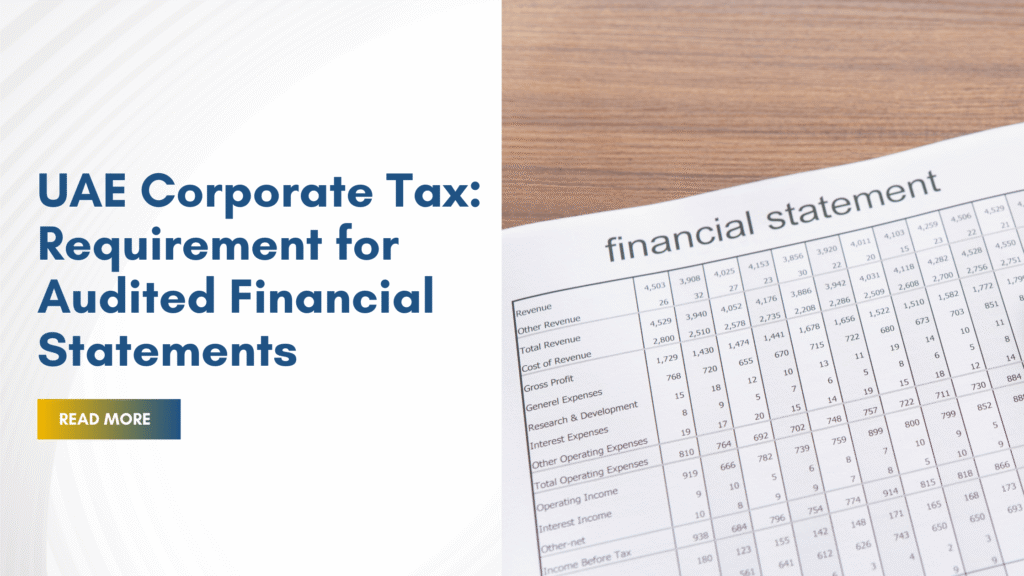
UAE Corporate Tax: AED 50 Million Audit Rule – Complete Guide
The UAE Corporate Tax regime has introduced a critical compliance requirement regarding audited financial statements. Under Ministerial Decision No. 84 of 2025, businesses must assess whether they are required to maintain audited financials based on specific criteria, including a key threshold of AED 50 million revenue.
🔍 Legal Framework
The requirement for audited financial statements is governed by:
- Federal Decree-Law No. 47 of 2022 on Corporate Tax
- Ministerial Decision No. 84 of 2025 on Audited Financial Statements
These regulations define when a Taxable Person must prepare and maintain audited financial statements for Corporate Tax compliance.
📊 AED 50 Million Rule – Core Requirement
A Taxable Person is required to prepare audited financial statements if:
- Annual Revenue exceeds AED 50,000,000 during the relevant Tax Period
- The entity is not part of a Tax Group
This threshold applies to both:
- Legal persons (companies)
- Natural persons conducting business activities
⚠️ Key Exceptions and Special Cases
1. Tax Groups
Entities forming part of a Tax Group are subject to a different rule:
- Audited financial statements are mandatory regardless of revenue
- No AED 50 million threshold applies
- Financials must be prepared on a Special Purpose Financial Statements (SPFS) basis
2. Qualifying Free Zone Persons (QFZP)
For Qualifying Free Zone Persons:
- Audit is mandatory irrespective of revenue
- Required to maintain eligibility for 0% Corporate Tax rate
3. Non-Resident Persons
For non-residents:
- The AED 50 million threshold applies only to UAE-sourced income or Permanent Establishment (PE) revenue
📌 Summary Table
| Category | Audit Requirement |
|---|---|
| Standalone Entity | Required if revenue exceeds AED 50 million |
| Tax Group | Mandatory (no threshold) |
| Qualifying Free Zone Person | Mandatory (no threshold) |
| Non-Resident Person | Based on UAE PE / UAE-sourced revenue |
🧠 Practical Implications
Understanding this rule is essential for Corporate Tax compliance and risk management:
- Tax Return Accuracy: Audited financials enhance reliability of reported figures
- FTA Scrutiny: High-revenue entities are more likely to be audited by authorities
- Transfer Pricing: Large businesses face stricter documentation requirements
- Compliance Risk: Failure to maintain audited financials may lead to penalties
🚨 Common Misconception
Many businesses assume that only large companies require audits. This is incorrect.
Even entities below AED 50 million must prepare audited financials if:
- They are part of a Tax Group
- They qualify as a Free Zone Person
📎 Official Reference
For full legal details, refer to the UAE Ministry of Finance:
UAE Ministry of Finance – Corporate Tax Resources
✅ Final Conclusion
The AED 50 million audit rule is a key compliance trigger under UAE Corporate Tax, but it does not apply universally. Businesses must carefully assess their classification—whether standalone, part of a Tax Group, or Free Zone entity—to determine their audit obligations.
A proactive approach to compliance ensures not only adherence to law but also stronger financial governance and reduced tax risk.
Frequently Asked Questions
What's Your Reaction?
 Like
0
 Dislike
0
 Love
0
 Funny
0
 Wow
0
 Sad
0
 Angry
0







Comments (0)