
UAE VAT — Complete Knowledge Base
Complete UAE VAT Guide 2026 covering VAT registration, Designated Zones, RCM, e-invoicing, penalties, exports, and compliance rules.

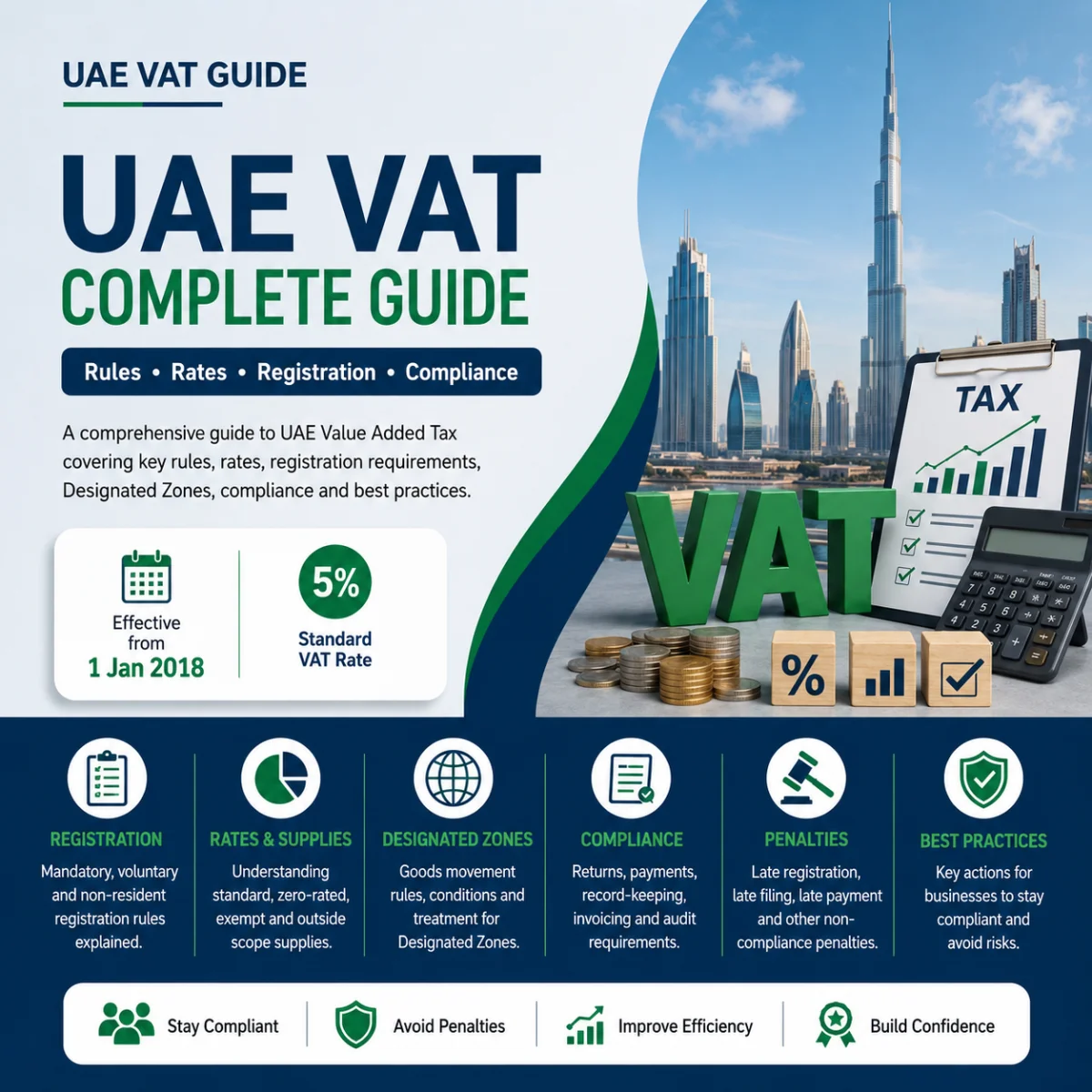
UAE VAT Guide 2026 – Complete Guide to VAT Registration, Designated Zones, Reverse Charge Mechanism & E‑Invoicing
The United Arab Emirates (UAE) Value Added Tax (VAT) system continues to evolve with significant amendments effective from 1 January 2026. Businesses operating in the UAE must understand VAT registration rules, Designated Zone treatment, input tax recovery, Reverse Charge Mechanism (RCM), penalties, and the upcoming mandatory e‑invoicing framework.
This comprehensive UAE VAT guide explains the latest VAT rules, compliance requirements, and practical considerations for businesses operating in the UAE.
1. Introduction to UAE VAT
UAE VAT was introduced on 1 January 2018 under Federal Decree-Law No. 8 of 2017 and later amended by Federal Decree-Law No. 16 of 2025, effective from 1 January 2026.
The standard UAE VAT rate remains 5%, administered by the Federal Tax Authority (FTA). VAT returns, payments, voluntary disclosures, and tax registrations are managed through the EmaraTax portal.
2. UAE VAT Registration Rules
Mandatory VAT Registration
Businesses must register for UAE VAT when taxable supplies and imports exceed AED 375,000 within a rolling 12‑month period or are expected to exceed this threshold within the next 30 days.
Failure to register within the required timeline may result in a penalty of AED 10,000.
Voluntary VAT Registration
Voluntary VAT registration is available where taxable supplies, imports, or expenses exceed AED 187,500.
This option is beneficial for startups and businesses with significant setup costs seeking to recover input VAT.
Non‑Resident VAT Registration
Non‑resident entities making taxable supplies in the UAE are generally required to register for VAT from day one unless the UAE customer accounts for VAT under the Reverse Charge Mechanism (RCM).
3. UAE VAT Rates & Supply Classifications
Standard Rated Supplies – 5%
Standard VAT at 5% applies to most goods and services supplied within the UAE unless specifically treated as zero-rated, exempt, or outside the scope of VAT.
Zero‑Rated Supplies – 0%
Zero‑rated supplies are taxable at 0%, allowing full recovery of related input VAT.
- Exports from UAE mainland
- International transportation
- Qualifying healthcare and education
- First supply of residential buildings
- Investment precious metals
Exempt Supplies
Exempt supplies are not subject to VAT and do not allow recovery of related input VAT.
- Residential resale properties
- Local passenger transport
- Certain financial services
- Life insurance
- Bare land
Outside Scope Transactions
Outside scope transactions are not considered taxable supplies under UAE VAT law and are not reported in VAT returns.
Important: Businesses commonly misclassify outside scope transactions as zero‑rated supplies, which can create serious compliance risks.
4. Designated Zones (DZ) Under UAE VAT
What Is a Designated Zone?
A Designated Zone is a fenced, customs‑controlled free zone recognized under UAE Cabinet Decisions.
Not all free zones qualify as Designated Zones. Only officially approved zones receive special VAT treatment.
Designated Zone VAT Treatment
For goods only, qualifying Designated Zones are treated as being outside the UAE for VAT purposes.
However, services provided within Designated Zones remain subject to standard UAE VAT rules.
Key Designated Zone Transactions
- Supply within same DZ: Outside scope
- Supply between DZs: Outside scope if customs conditions are met
- Supply from DZ to mainland: Treated as import into UAE mainland
- Supply from mainland to DZ: Zero‑rated export from mainland
- Export from DZ to outside UAE: Outside scope
Critical DZ Importer of Record Rule
Once goods move from a Designated Zone into the UAE mainland under a DZ entity’s customs declaration, the goods become fully subject to UAE VAT rules.
The importer must account for VAT under the Reverse Charge Mechanism and charge VAT on onward local supplies.
5. Reverse Charge Mechanism (RCM) in UAE VAT
The UAE Reverse Charge Mechanism applies where the recipient, rather than the supplier, accounts for VAT.
When Does RCM Apply?
- Imported services from outside UAE
- Goods imported into UAE
- Goods transferred from Designated Zones to mainland UAE
How RCM Works
The VAT‑registered recipient reports output VAT in Box 3 and claims the same as input VAT in Box 9, subject to normal recovery rules.
Failure to complete both boxes correctly is considered a VAT compliance error.
6. Input VAT Recovery Rules
Recoverable Input VAT
Input VAT is recoverable where:
- The business is VAT registered
- The expense relates to taxable supplies
- A valid tax invoice is available
Blocked Input VAT
- Entertainment expenses
- Personal-use motor vehicles
- Expenses linked to exempt supplies
- Non‑mandatory employee benefits
New Anti‑Evasion Input VAT Rules
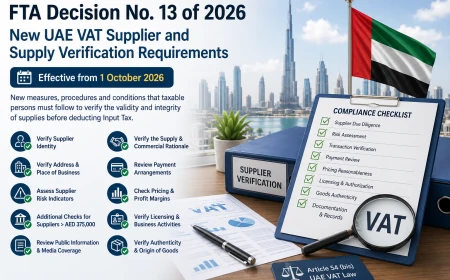
Effective from 1 January 2026, the FTA may deny input VAT recovery where businesses knew or should have known that transactions were linked to tax evasion.
Businesses are now expected to conduct reasonable supplier due diligence, including TRN verification and VAT treatment review.
7. UAE E‑Invoicing Requirements
E‑Invoicing Timeline
- Pilot Phase: July 2026
- Mandatory Rollout: January 2027 for large businesses
E‑Invoicing Requirements
UAE businesses will be required to issue invoices in structured digital formats such as XML, JSON, or UBL through an FTA‑Accredited Service Provider (ASP).
E‑Invoices must generally be reported within 14 days and archived for at least 5 years.
8. VAT Penalties in UAE
UAE VAT penalties were revised under Cabinet Decision No. 129 of 2025.
| Violation | Penalty |
|---|---|
| Failure to Register | AED 20,000 |
| Late VAT Return Filing | AED 1,000 to AED 2,000 |
| Failure to Maintain Records | Up to AED 50,000 |
| Failure to Issue Tax Invoice | AED 2,500 per case |
| E‑Invoicing Non‑Compliance | AED 5,000 per month |
9. Voluntary Disclosure (VD)
Businesses must file a Voluntary Disclosure (VD) when VAT errors or omissions are identified.
Early correction significantly reduces penalties. Delayed disclosures may attract monthly penalties and additional penalties after audit notification.
10. Conclusion
The UAE VAT framework is becoming increasingly sophisticated with stronger enforcement, expanded e‑invoicing obligations, and enhanced anti‑evasion measures.
Businesses should proactively review their VAT compliance processes, Designated Zone treatment, ERP systems, and invoicing structures to ensure full compliance with the latest FTA requirements.
Need professional VAT advisory or e‑invoicing implementation support?
Contact SA Consultants for VAT assessment, VAT health checks, e‑invoicing readiness review, and tax compliance support in the UAE.
UAE VAT FAQ
1. Are exports of services zero-rated in UAE VAT?
Yes, exports of services are generally zero-rated (0%), provided all conditions are met. These include that the recipient is outside the UAE, has no UAE establishment benefiting from the service, and the service is not directly connected to the UAE.
2. Does export of services ever become out of scope?
No. Export of services is still a taxable supply and therefore within the scope of VAT. It can either be zero-rated (0%) or standard-rated (5%) if conditions fail. It does not become out of scope unless there is no supply or the place of supply is outside UAE.
3. What does “out of scope” mean in UAE VAT?
Out of scope transactions are those that do not fall under UAE VAT at all. This happens when:
- No supply exists (e.g., salary, pure reimbursement)
- Place of supply is outside UAE
- Transaction is between branches of the same legal entity
4. What are the key conditions for zero-rating export of services?
- Customer must be outside UAE
- No UAE fixed establishment benefiting
- Service must not be used in UAE
- Service must not relate to UAE real estate
5. What happens if export conditions are not met?
If any condition fails, the supply becomes standard-rated at 5%. It does not become out of scope.
6. How to determine if a transaction is a taxable supply?
- Is there a supply (goods/services for consideration)?
- Is it made by a taxable person?
- Is the place of supply in UAE?
- Is it in the course of business?
If all answers are yes, it is a taxable supply.
7. What is the place of supply for services?
Generally:
- B2B: Customer location
- B2C: Supplier location
8. What is the Use & Enjoyment rule?
The Use & Enjoyment rule is an override mechanism that adjusts the place of supply based on where the service is actually consumed.
9. Where is the Use & Enjoyment rule located?
It is provided under Article 31 of the UAE VAT Executive Regulations, which deals with special cases of place of supply.
10. Does Use & Enjoyment apply to all services?
No. It applies only to specific categories such as:
- Telecommunication services
- Electronic services
- Certain cross-border transactions
It does not generally apply to IT consultancy services.
11. How does Use & Enjoyment affect VAT treatment?
- If service is deemed outside UAE but used in UAE → 5% VAT
- If service is deemed in UAE but used outside UAE → Out of Scope
12. What is the difference between zero-rated and out of scope?
- Zero-rated: Taxable supply at 0% (reported in VAT return)
- Out of scope: Not a taxable supply (not reported)
13. What is the UAE VAT legal hierarchy?
- Decree-Law: Main VAT law
- Executive Regulations: Detailed implementation rules
- Cabinet Decisions: Special cases and policies
- Ministerial Decisions: Administrative details
- FTA Guidance: Practical interpretation
14. Where is the Use & Enjoyment rule positioned in the hierarchy?
It is part of the Executive Regulations, specifically under place of supply provisions.
15. What is the correct VAT decision framework?
- Confirm if a taxable supply exists
- Determine place of supply
- Apply Use & Enjoyment if relevant
- Check zero-rating conditions
16. Example – UAE IT consultancy to UK company
- Used outside UAE → 0% VAT
- Used by UAE branch → 5% VAT
- Supplied entirely outside UAE → Out of Scope
17. What documentation is required for zero-rating?
- Contract with foreign client
- Proof of customer location
- Invoices
- Payment records
- Evidence of use outside UAE
18. What are common mistakes in VAT classification?
- Assuming foreign client = out of scope
- Ignoring use & enjoyment rules
- Relying only on invoice wording
- Not verifying customer establishment
19. Can a client rely on supplier’s VAT treatment?
No. The client must independently verify whether the transaction is taxable, zero-rated, or out of scope.
20. What is the final takeaway?
Export of services is generally zero-rated, not out of scope. Out of scope applies only where there is no supply or the place of supply is outside UAE. Proper classification requires careful analysis of place of supply and applicable rules.
Frequently Asked Questions
What's Your Reaction?
 Like
0
 Dislike
0
 Love
0
 Funny
0
 Wow
0
 Sad
0
 Angry
0




Comments (0)