
UAE Corporate Tax Return: Why the Shareholding Details Section Deserves Your Attention
Learn why the Shareholding Details section in the UAE Corporate Tax Return is crucial for Transfer Pricing, restructuring, ownership changes, and FTA compliance.

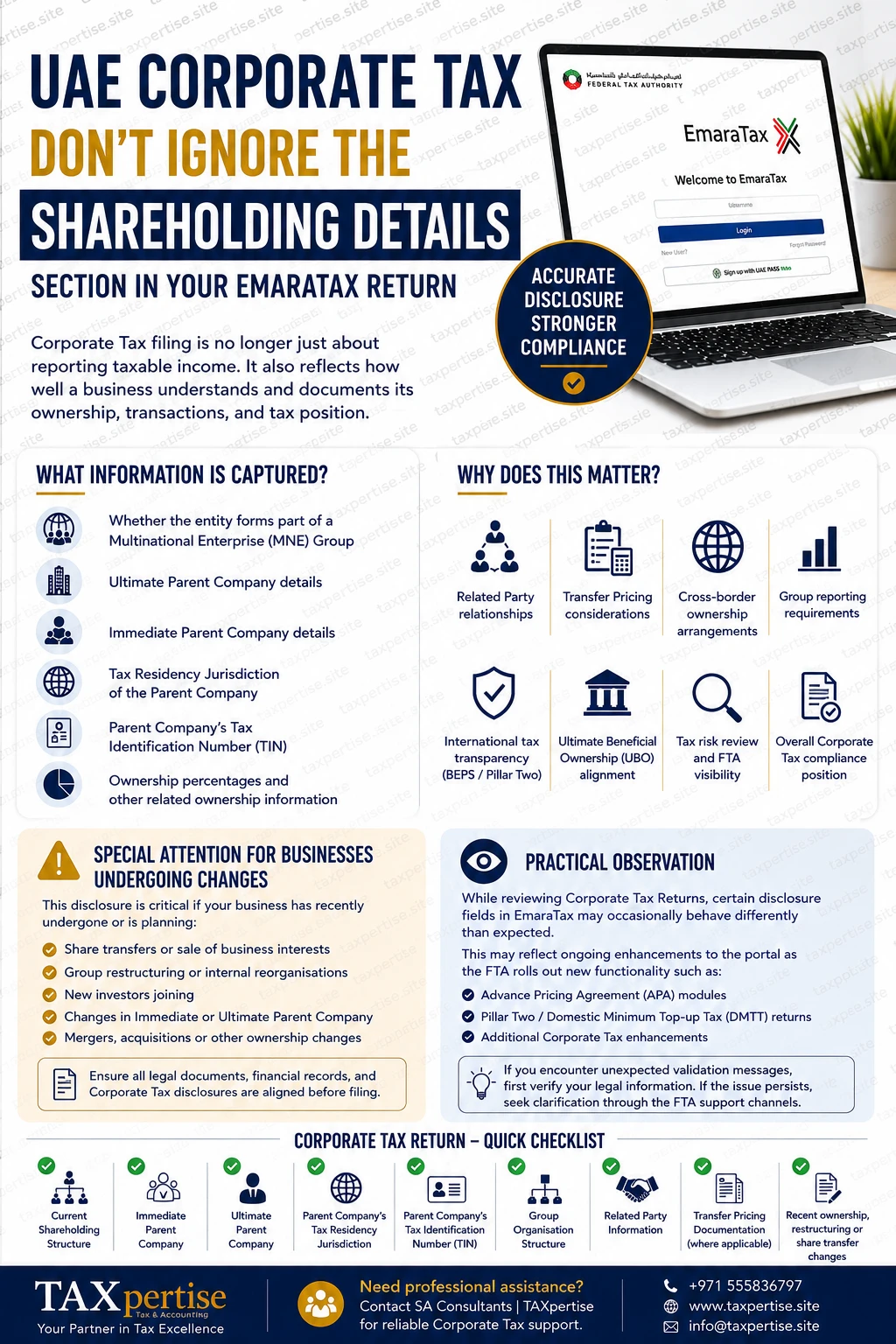
UAE Corporate Tax Return: Why the Shareholding Details Section Deserves Your Attention
As UAE businesses prepare to file their Corporate Tax Returns through EmaraTax, most attention is naturally focused on taxable income, deductible expenses, and tax calculations.
However, one section is increasingly becoming just as important from a compliance perspective:
Shareholding Details
Many taxpayers consider this section to be a simple administrative disclosure. In reality, it provides the Federal Tax Authority (FTA) with valuable insight into a company's ownership structure, group relationships, and international tax profile.
As the UAE Corporate Tax framework continues to evolve, businesses should ensure that this information is complete, accurate, and consistent with their legal, accounting, and tax records.
What Information Does the Shareholding Details Section Capture?
The Corporate Tax Return requires businesses to disclose ownership information such as:
- Whether the entity forms part of a Multinational Enterprise (MNE) Group
- Ultimate Parent Company details
- Immediate Parent Company details
- Tax Residency Jurisdiction of the Parent Company
- Parent Company's Tax Identification Number (TIN)
- Ownership percentages and related ownership information
Although these disclosures appear straightforward, they are an important part of the FTA's broader compliance framework.
Why Does This Matter?
The ownership information reported helps the FTA understand the overall tax profile of a business and supports its review of:
- Related Party relationships
- Transfer Pricing obligations
- Cross-border ownership arrangements
- Group reporting consistency
- Ultimate Beneficial Ownership (UBO) alignment
- International tax transparency initiatives
- BEPS and Pillar Two considerations (where applicable)
- Overall Corporate Tax compliance
Corporate Tax compliance is no longer limited to calculating taxable income. It also reflects how well a business understands, documents, and substantiates its ownership structure and governance.
Businesses Undergoing Ownership Changes Should Pay Special Attention
The Shareholding Details section becomes even more critical for businesses that have recently undergone—or are planning—ownership or group structure changes.
Examples include:
- Share transfers
- Sale of shares or business interests
- Introduction of new investors
- Group restructuring
- Internal reorganisations
- Mergers and acquisitions
- Changes to the Immediate Parent Company
- Changes to the Ultimate Parent Company
Following any ownership change, businesses should ensure that all legal documents and Corporate Tax disclosures are updated before filing the return.
Maintain Consistency Across All Corporate Records
The ownership information reported in EmaraTax should align with supporting documentation, including:
- Trade Licence
- Memorandum of Association (MOA)
- Share Register
- Ultimate Beneficial Owner (UBO) records
- Audited Financial Statements
- Group Organisation Chart
- Transfer Pricing documentation (where applicable)
- Intercompany Agreements
- Board Resolutions approving ownership changes
Any inconsistency between these records may lead to additional queries from the FTA during a compliance review or future tax audit.
Common Mistakes Businesses Should Avoid
- Reporting an incorrect Ultimate Parent Company
- Selecting the wrong tax residency jurisdiction
- Leaving the Parent Company's Tax Identification Number (TIN) blank where available
- Failing to update ownership changes before filing
- Reporting information inconsistent with legal documents
- Assuming these disclosures are merely informational
Even small inconsistencies can result in unnecessary compliance queries and additional documentation requests.
Practical Observation from SA Consultants
During our review of Corporate Tax Returns, we have observed that certain Shareholding disclosure fields within EmaraTax may occasionally behave differently than expected.
This may simply reflect the continuous enhancements being made to the platform as the FTA introduces additional Corporate Tax functionality, including:
- Advance Pricing Agreement (APA) modules
- Pillar Two / Domestic Minimum Top-up Tax (DMTT) Returns
- Additional international tax reporting requirements
- Ongoing enhancements to the EmaraTax portal
If you encounter unexpected validation messages or unusual portal behaviour, first verify that your ownership information and supporting documents are correct. If the issue persists, it may be appropriate to seek clarification through the FTA's official support channels.
As the UAE Corporate Tax system continues to mature, businesses should expect periodic updates and enhancements to EmaraTax.
Corporate Tax Filing Checklist
Before submitting your Corporate Tax Return, ensure you have verified:
- ✅ Current Shareholding Structure
- ✅ Immediate Parent Company
- ✅ Ultimate Parent Company
- ✅ Parent Company's Tax Residency
- ✅ Parent Company's Tax Identification Number (TIN)
- ✅ Group Organisation Structure
- ✅ Related Party Information
- ✅ Transfer Pricing Documentation (where applicable)
- ✅ Recent ownership, restructuring, merger, or share transfer changes
Final Thoughts
The Shareholding Details section is much more than an administrative requirement.
It provides the Federal Tax Authority with valuable insight into your company's ownership, group relationships, and international tax profile.
For businesses that are part of multinational groups—or those that have recently undergone restructuring, ownership transfers, mergers, acquisitions, or group reorganisations—accurate disclosure is essential for Corporate Tax compliance.
As the UAE Corporate Tax regime continues to evolve, maintaining consistency across legal, financial, and tax records will not only support smoother compliance but also reduce the risk of unnecessary FTA queries during future reviews.
Need Professional Assistance?
At SA Consultants | TAXpertise, we help businesses confidently navigate UAE Corporate Tax compliance through:
- Corporate Tax Return Preparation & Review
- EmaraTax Filing Assistance
- Shareholding & Ownership Structure Reviews
- Transfer Pricing Compliance
- Related Party Transaction Reviews
- Corporate Tax Advisory
- Group Restructuring Tax Analysis
- Pillar Two & International Tax Advisory
Need assistance before filing your Corporate Tax Return?
Contact TAXpertise to ensure your EmaraTax submission is accurate, compliant, and fully aligned with UAE Corporate Tax requirements.
What's Your Reaction?
 Like
0
 Dislike
0
 Love
0
 Funny
0
 Wow
0
 Sad
0
 Angry
0









Comments (0)