
UAE Corporate Tax Transitional Rules Explained (CTP009 – MD 120 of 2023 Guide)
Complete guide on UAE Corporate Tax Transitional Rules under Ministerial Decision 120 of 2023 and FTA Clarification CTP009. Learn valuation methods, conditions, and compliance.

UAE Corporate Tax Transitional Rules Explained (CTP009 – MD 120 of 2023)
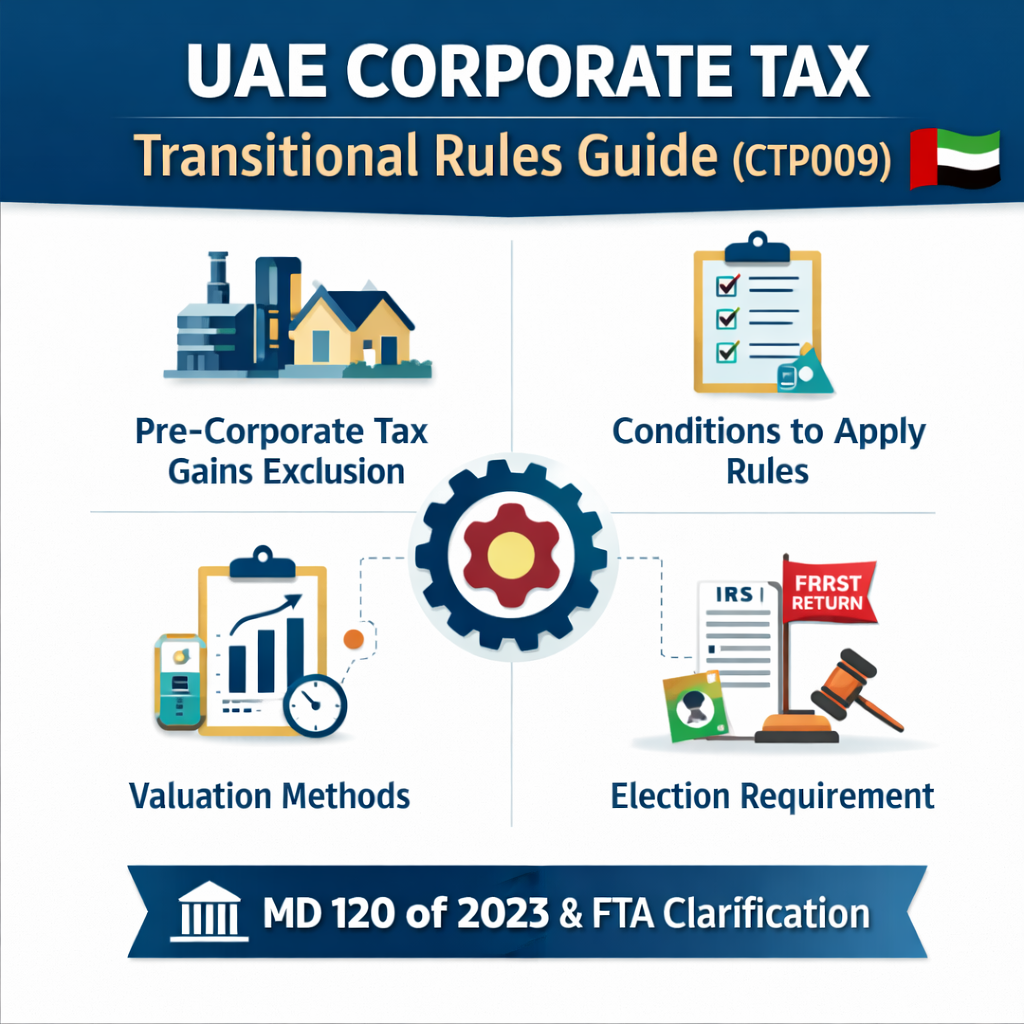
The introduction of UAE Corporate Tax required a structured transition from the pre-tax regime to the new taxation framework. To address this, the Ministry of Finance issued Ministerial Decision No. 120 of 2023, followed by FTA Public Clarification CTP009 in 2025, providing detailed guidance on how transitional rules apply—particularly for Qualifying Immovable Property (QIP).
This article provides a technical and practical breakdown of transitional rules, valuation methods, and compliance requirements.
What are Transitional Rules in UAE Corporate Tax?
Transitional rules ensure that gains accrued before the implementation of Corporate Tax are not unfairly taxed. These rules apply to assets held before the first tax period and allow businesses to adjust their taxable income accordingly.
-
Immovable property
-
Intangible assets
-
Financial assets and liabilities
The objective is to provide a fair and transparent transition into the Corporate Tax regime. :contentReference[oaicite:0]{index=0}
Key Principle: Exclusion of Pre-Tax Gains
Under transitional rules, businesses can exclude gains attributable to the pre-Corporate Tax period when an asset is disposed of in the future.
This prevents taxation of unrealized gains that arose before the Corporate Tax law became effective. :contentReference[oaicite:1]{index=1}
Conditions to Apply Transitional Rules
To qualify for adjustments under MD 120 of 2023, the following conditions must be met:
-
Asset must be owned before the first Tax Period
-
Asset must be recorded at historical cost
-
Asset must be disposed of after Corporate Tax implementation
These conditions apply across all relevant asset classes. :contentReference[oaicite:2]{index=2}
Valuation Methods under Transitional Rules
1. Market Value Method
This method allows exclusion of gains based on the market value at the start of the first Tax Period.
-
Market Value – Higher of Cost or Net Book Value
-
Difference is excluded from taxable income
This method is particularly beneficial where assets have significantly appreciated in value. :contentReference[oaicite:3]{index=3}
2. Time Apportionment Method
This method allocates gains based on the period of ownership before and after Corporate Tax implementation.
-
Pre-tax ownership portion is excluded
-
Post-tax gains remain taxable
This approach is useful where valuation data is limited or complex. :contentReference[oaicite:4]{index=4}
FTA Clarification CTP009 – Key Highlights
The FTA issued CTP009 to clarify the application of transitional rules specifically for real estate developers.
Important Clarifications:
-
Applies to projects spanning pre- and post-tax periods
-
Applies regardless of accounting classification (inventory vs fixed asset)
-
Only assets existing before the first tax period qualify
-
Partial project gains must be allocated on a fair and reasonable basis
This significantly impacts real estate developers with ongoing projects. :contentReference[oaicite:5]{index=5}
Election Requirement (Critical)
To apply transitional rules:
-
Election must be made in the first Corporate Tax Return
-
Applies per asset or asset class
-
Once selected, it is irrevocable (except with FTA approval)
This makes early tax planning extremely critical. :contentReference[oaicite:6]{index=6}
Common Practical Challenges
-
Determining accurate market value
-
Separating pre-tax vs post-tax gains
-
Handling partially completed projects
-
Aligning accounting records with tax rules
Expert Advisory Insight
From a tax advisory perspective, transitional rules are one of the most strategic areas in UAE Corporate Tax.
-
Early evaluation of assets is essential
-
Valuation reports must be defensible
-
Election decisions can significantly impact future tax liabilities
-
Real estate sector requires special attention
Conclusion
The UAE Corporate Tax transitional rules under MD 120 of 2023, supported by FTA Clarification CTP009, ensure that businesses are taxed fairly during the transition into the Corporate Tax regime.
However, due to their technical complexity and long-term financial impact, businesses should undertake a detailed tax assessment before making elections.
What's Your Reaction?
 Like
0
 Dislike
0
 Love
0
 Funny
0
 Wow
0
 Sad
0
 Angry
0











Comments (0)